Welcome!

We started this blog in 2010 after a New Years' Resolution to read 60 books between the two of us. (40 for C, 20 for D.) After reaching our goal, we decided to keep going in 2011. This year, C has pledged to read 30 books, and D will read 12. By no means are we professional reviewers; we're not even professional bloggers. We're just two people who love to read and decided to share our thoughts and offer our limited insights. We hope you enjoy!

Sunday, September 26, 2010

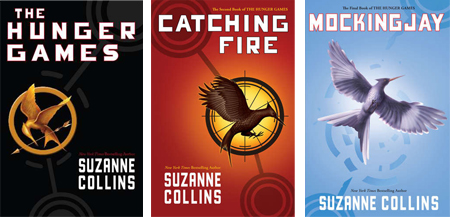
The Hunger Games Trilogy (11-13)

I started The Hunger Games last Monday, and really didn't spend much time with the actual book in my hand.  The Audible version, narrated by Carolyn McCormick instead made my hour-plus commute much more enjoyable than usual.

I don't plan to go into too much detail where plot points are concerned, as Chassi has already hit the main points in her posts on The Hunger Games and Catching Fire, and I want to save the meat of the Mockingjay review for her since she's the reason I read this series in the first place.

I will echo her sentiment that the world Collins builds in the trilogy is very reminiscent of the world of Lois Lowry's The Giver, which I thoroughly enjoyed.  The way Collins plays on the (dis)connectedness of those in the districts and the power and control of those in the Capitol makes for a heart-felt and finely crafted world.  My only complaint in this area is the lack of a map, but that just may be the fantasy novel lover inside of me. 

The story itself is extremely compelling, playing on both the action and the emotional aspects and motivations of the characters.  In places, it brings in quite a bit of social commentary, which is always a plus in my opinion.  My complaint here is the tired trope of so many YA books with female heroines--the woe-is-me, Team Peeta-Team Gale love triangle.  A little less focus on that and a little more focus on the social aspects would have served the story well.

As far as the end of the trilogy, parts of it seemed a bit rushed.  At first, I was disappointed in the final chapter of Mockingjay, but the epilogue saved it for me.  In fact, the more I reflect on the book, the more I understand why Collins had to end it the way she did.

Overall, this was a great trilogy, especially for young adults, but with plenty to offer for older readers as well.

4.5/5 Stars


--D

Friday, September 24, 2010

Book #25 -- The King's Nun

As a historian of sorts (a degree in history and social science education counts as being a historian, right?), I was drawn to this book because of its historical theme… Oh, yeah, and also because it was in the big box of $1 books at Books-A-Million. Admittedly, I knew as soon as I read the description on the back that it very well could have been a cheesy, terrible romance-esque novel, but I’m proud to say that it wasn’t. My $1 and I are pleased.

Catherine Monroe's The King's Nun is about a young soon-to-be nun named Amelia who is chosen by her abbess to lead King Charlemagne on a tour of their monetary when he comes to visit. The monetary is in need of some financial aide, and Amelia’s job is to convince the king to give them some dough. When King Charlemagne arrives, Amelia realizes that she’s met him before, only she didn‘t know he was the king back then. Juicy, right?

King Charlemagne is impressed with Amelia’s intelligence, and soon he sends for her to come to the palace to advise him on some family issues. She’s not too thrilled about it, but she and the king become very close over the course of her stay at the palace. Not close like that, you gutter-minded animals, but, you know, emotionally close. Sort of. But eventually the king has to go to war with those dirty Saxons, and Amelia goes on with her life. I’d say the vast majority of the novel doesn’t even taken place with Amelia and Charlemagne in the same place.

Anyway, this easily could’ve taken a turn for the trashy side, but it really didn’t. There are no gratuitous sexual scenes, no mention of “loins,” and no trite happily-ever-after ending. I like that. Because of the subject matter, it kind of reminded me of The Pillars of the Earth by Ken Follett, which is hands-down my favorite book ever. Monasteries and royals and history and all that.

I feel like I should mention one tiny thing that bothered me, even though I know I’m a total snob and this wouldn’t bother most normal people. The chapters go back and forth between Amelia’s point of view and Charlemagne’s point of view, which is totally fine. The problem is that Amelia’s chapters are written in the first person and Charlemagne’s are written in the third person limited. Why does that bother me? I don’t have a clue, but it did. I’m cool with bouncing to different view points (in fact, I think most of my favorite books do that), but aaarrgghhh, keep it in the same person.

All in all, it was a quick, entertaining little story, and I think it was well worth my time. I dare say it might have even been worth more than I paid for it.

3 out of 5 stars

Read from September 14, 2010 to September 22, 2010

--C

Sunday, September 12, 2010

Book #24: Far from Xanadu

When I read Between Mom and Jo by Julie Anne Peters in June, I said I'd be adding her to my list of authors to look for in the bookstore. Luckily, I happened upon another of her books shortly afterward. As I mentioned in my last review, Peters generally writes about LGBT issues, sooo... not for everyone, I suppose, but I think she's brilliant.

In Far From Xanadu, the narrator, Mike is a buff teenage softball player in a small farm town who falls madly in love with Xanadu, the new girl at school who has a checkered past. Xanadu and Mike become best friends instantly, and Mike holds on to the hope that one day, they'll be more than friends. The problem, of course, is that Mike (whose full name is Mary-Elizabeth) is a girl. And Xanadu is straight.

What could have been a trite, predictable teenage story about forbidden/unrequited love or whatever (*cough*TWILIGHT*cough*) is actually a powerful novel about finding and loving yourself. Mike's got a lot more going on in her life than just the situation with Xanadu, especially within her own family. Her father recently committed suicide, her mentally unstable and morbidly obese mother hasn't spoken to Mike since the suicide, and her older brother has failed miserably at running the household and business in their father's place. Everything around her is in shambles, but she's struggling to find a way to pick herself up by the bootstraps and do something with her life. She thinks her ticket to happiness might be Xanadu. What she needs to figure out is how to be her own ticket to happiness.

I'm telling you, Julie Anne Peters is a master when it comes to writing emotions. I said the same thing when I reviewed her last book. You feel everything her characters feel -- it's incredible. It's a great read for anyone, I think, because I'm pretty sure everyone can look back at their teenage years and relate to Mike's situation. Maybe not as extreme, but, you know, teenagers are dramatic no matter how extreme or not-so-extreme the situation may be. What I really like about Peters' books is that I can absolutely see how integral and maybe even life-changing they could be to a teenager who is struggling with being "different," whether it's sexuality or something else. Any author that can use his/her gift to help other people is A+ in my book, and I think Peters is a master at that.

5 out of 5 stars

Read from September 5, 2010 to September 13, 2010

--C

Book #23: In the Weather of the Heart

So, I finished this book a week ago, but I've been putting off reviewing it. I'm not really sure what to say about it.

In the Weather of the Heart is Valerie Monroe's memoir about struggling through her husband Keith's addiction to cocaine and prescription medication. His addiction is spurred by the bizarre suicide of his identical twin brother, who was also a severe addict. Monroe writes about getting through her Keith's rehab, his lack of parenting to their young son, and their crumbling marriage.

As you may know, I'm a sucker for a book (especially a memoir) about addiction or abuse or murder or suicide. My heart is black and made of stone like that. I figured this book was right up my alley, but I was kind of left feeling empty. I have enormous respect for Monroe and her husband for getting through such a difficult time, and it was inspiring to a certain degree, but I didn't have that feeling of triumph and love-will-conquer-all or whatever when I finished this. It was actually really depressing. I know what you're thinking: of course it was depressing -- the guy's twin brother killed himself and then he became addicted to drugs. I get that, but I think it was Valerie and Keith's relationship that depressed me. It didn't sound to me much like they actually loved each other before any of this happened. I guess I kind of felt like they didn't have a marriage worth much in the first place, so why fight so hard to keep it? I don't know. You see why I put off this review? My thoughts don't even make sense.

Even though it was what bothered me about the book, Valerie and Keith's relationship (or lack thereof) is actually the heart of the book. I think the point may have been that Keith's addiction eventually made their marriage better. Hm.

Anyway, I enjoyed the book, and it's beautifully written. I'm by no means passing judgment on either one of them as individuals, since I have literally no business judging the actions of attitudes of people in this kind of situation since I've (thankfully) never been there. I think they're both brave and wonderful people in their own ways, but I just didn't get much from the book.

3 out of 5 stars

Read from August 29, 2010 to September 5, 2010

--C

Sunday, August 29, 2010

Book #22: The Star of Kazan


Hello, all. It's me, Slacker Central, with my first book review in a month! Working mighty hard toward that 40 book goal, aren't I?

No, seriously. Sorry about my disappearance. I had this whole job search/wedding planning thing going on. I started this book a month ago, read half of it in a couple days, put it down for weeks, and then finished the rest of it in two days. Weird how that works.

So, The Star of Kazan is a young adult book by Eva Ibbotson about a young girl named Annika who was found as an infant by a couple of servant women. The two women, Ellie and Sigrid, convince their masters (three haughty professors) to let them raise the child as their own and teach her to cook, clean, and run the household. She grows up happy and industrious in Vienna, but one day her entire world is turned upside down when her birth mother comes to retrieve her and take her to a land known as Spittal.

As it turns out, her mother is Austrian nobility, a 'von Tannenburg,' and Annika suddenly goes from being raised as a servant child to living the life of an aristocrat. She doesn't adjust too terribly well to her new lifestyle, and she misses her family and friends. Not long after Annika is taken to Spittal, an old family friend back in Vienna passes away and leaves Annika a worthless trunk of keepsakes. Everything isn't exactly what it seems when it comes to the unexpected inheritance, and Annika has a lot of unanswered questions about her past and her future.

I liked this book a lot, but it has one big, fat problem: pacing. It starts out really slow and stays really slow until, I would say, more than half-way into the book. At 405 pages, it's pretty hefty for a young adult book (although it does have a few illustrations thrown in here and there). To go that far without really picking up the pace of the plot is a good way to make your readers put the book down for, oh, say... three weeks. Which is exactly what I did. It just seemed like a lot of backstory. In hindsight I understand that it was necessary backstory, but there had to have been a better way to execute it.

The last 1/3rd of the book is totally worth it, though. I read it in a few hours and didn't want to put it down. The end made this book great. Also, the characters in the book are all likable, even the ones you eventually learn that you shouldn't like so much. I think Ibbotson does a fantastic job of keeping you guessing as to who should and shouldn't be trusted. As a more mature reader, you obviously pick up on a bit more than a 10- or 11-year-old might, but keeping the intended audience in mind, the character development is impressive.

I would recommend this book, especially to an older elementary school kid, but I think most adults would enjoy it, too. You've been warned, though -- it's tough to stick with it through those first 250 pages.

3.5/5 stars

Read from July 27, 2010 to August 29, 2010

--C

Tuesday, July 27, 2010

Book #21: The Cracker Queen

You've got to love a slightly crazy Southern woman. Look at Dolly Parton or Paula Deen. Kinda nutty, questionable decisions (whether it's multiple plastic surgeries or multiple sticks of butter in one recipe), annoying accents, but completely lovable. That's what this book is all about, and that's what a "Cracker Queen" is all about.

The author of The Cracker Queen: A Memoir of a Jagged, Joyful Life, Lauretta Hannon, describes in the first few pages exactly what her term "Cracker Queen" means to her:

"The Cracker Queen is a strong, authentic Southern woman. She is the anti-Southern Belle. She has a raucous sense of humor and can open a can of whup-ass as needed. [...] The Cracker Queen knows loss and hurt; these things have made her beautiful, resourceful, and, above all, real."

I think my maternal grandmother may have been a Cracker Queen. Actually, I'm sure she was. Lauretta Hannon believes that she herself is a Cracker Queen, and this is her memoir of growing up in the South in a family full of fellow Queens. The introduction to the book goes into great detail about this honorable title and why it's important. The rest of the book is divided into three parts. In the first part, Hannon describes her childhood, including her parents' strained and violent marriage, her mother's alcoholism, and the death of her father. The second part is about Hannon in adulthood and how she carried the ways of the Cracker Queen into her professional and personal life. The third (and very short) part reads like a self-help book -- how to become a Cracker Queen yourself, including the attitudes and traits you need to accomplish it.

This book reminded me a lot of The Glass Castle by Jeanette Walls, just because it shares Jeanette's story of growing up poor in a not-so-great home. The tone behind The Cracker Queen is humor, but there's a lot of sadness in this book. Some of the events that Lauretta describes are heart-breaking, but her attitude helps her persevere. It's overall a very positive book, because her purpose is to show the reader that no matter what's going on in your life, your attitude can change your situation. You can either wallow in self-pity, or truck on through life and try to have fun while you're at it.

Other than the fact that we share a Southern heritage, Hannon and I also share a career in education. She's not a teacher, but she works with students in universities. Hannon is now a writer, humorist, and contributor to National Public Radio, but from what I understand, she still works in marketing at a small technical college in Atlanta. There's a lot to be said for working with students (even college students), especially at a school where your students may not come from the best situations. I've been there, and it really does change how you look at things. There's a quote in Part II of this book that stuck out for me:

"The truth is that the bad days at work are the best, too, because they remind me of the urgency of our mission. It goes far deeper than education: We are soul warriors."

There's a lot of truth in that. Kids all over the world could stand to take a tip or two from a Cracker Queen. They may have grown up poor, in bad homes, and gone through far too much for a child to have to go through, but your life can turn around. I think that's what's at the heart of this book. I'd recommend it to anyone, Southern or not.

Read from July 25, 2010 to July 26, 2010

5/5 stars

--C

Sunday, July 25, 2010

Book #20: No Mercy

Ah, my first Kindle book. If you know anything about me at all, you know that I can pinch a penny better than anyone in the world. I would guess that 90% or more of the books I own are used, and you all remember how I raved about Big Lots' fifty cent book sale. You obviously can't buy used books on the Kindle, but they do have a selection of books for around $1 and many for free (especially classics). This was one of the cheap ones. It was decent, but I'm glad I didn't pay much for it.

No Mercy centers around Jonathan Grave, the owner and main employee of a company that essentially exists to do illegal things. Not bad illegal things, but illegal things. Jonathan is a former army specialist with experience doing rescue missions in just about every environment. So, naturally, he now makes his living as a hired vigilante. If your kid gets kidnapped by thugs who warn you not to get the police involved, you call Jonathan Grave.

And that's exactly what happens in No Mercy. The book opens with Jonathan rescuing a college student named Thomas Hughes, who is being held captive on a large property in rural Indiana. Jonathan doesn't know why Thomas was captured in the first place, but he finds out soon enough. It turns out to be a long, twisted, complicated story that involves some of Jonathan's own friends, homeland terrorists, and a lot of other things. I'm not quite sure exactly what was going on, to be honest. Matters are complicated even further when local police have to clean up the mess Jonathan left when he rescued Thomas. As far as the sheriff is concerned, even though Jonathan was a hero and saved the victim, he still has to be punished for taking the law into his own hands. So, the books takes us through Jonathan running from the Indiana police, all while trying to solve the problem that got Thomas kidnapped in the first place.

It took me forever to read this, considering the pace at which I usually read. I juuuust wasn't into it. Parts of it were really good, but then it would get boring and weird again. I felt like the logistics of the whole situation were really complicated, but I think part of it was that it just wasn't that interesting to me. I don't have trouble following a complicated conspiracy plotline (I mean, hello, Stieg Larsson's Millennium trilogy), but only if they're interesting. Maybe this particular plot just wasn't my thing, because I don't think Gilstrap is a bad author. The situation just didn't really grab me.

Apparently he's written an entire series of books with Jonathan Grave and his crew, which is cool. I liked Jonathan. He wasn't afraid of anything, and he had very clear definitions of right and wrong. He didn't care that he had no authority to kill bad guys. He did it anyway, because they were bad guys. Makes sense to me, but to a lot of characters in the book (and probably a lot of people in the world), you let the cops or the FBI or the military worry about bad guys. Your job is to report them, not kill them. So, there's a lot of line-blurring when it comes to good and evil in this book. I liked that. I also liked that Jonathan's sidekick, Boxers, referred to their Hummer as the Batmobile. That was awesome.

Here are two of my favorite quotes from the book, which I marked with my handy "Clippings" gadget on the Kindle:

"Protesting others' decisions is always easier than making your own."
"A career is a poker game. You can't expect to win every hand. Sometimes you have to fold to preserve resources for the future."

All in all, I didn't love this book, but I still don't think it was bad. Just, you know, not generally my thing. If you like, say, Tom Clancy or any kind of crime thriller, then pick this up for sure.


Read from July 7, 2010 to July 25, 2010.

2.5/5 stars.

--C