As much as I enjoy historical fiction, it may come as a surprise that I've never read anything by Philippa Gregory. She's pretty much the queen of historical fiction, best known for The Other Boleyn Girl. After reading this, I think it might be safe to say it's the start of a beautiful relationship between Philippa and I.
The White Queen is the first in a series of books about the Plantagenet royals in England. At the center of this book is the War of the Roses -- the war between the Yorks and the Lancasters for the rightful heir to the throne. The Lancasters were symbolized by a red rose, the Yorks by a white rose -- hence the title The White Queen. (The next book in this series is The Red Queen, written about Lancastrian heiress Margaret Beaufort).
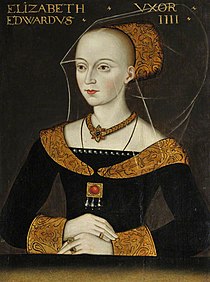
Elizabeth Woodville is the narrator of The White Queen, and she is a very intriguing character indeed. Elizabeth was originally from the House of Lancaster, with both her father and husband fighting in the War of the Roses against the Yorks, who had already placed Edward IV on the throne. Her husband died in battle, and Elizabeth was widowed with two young sons and a difficult set of in-laws. As historical legend has it, Elizabeth stood on the side of the road waiting for Edward IV to pass with his army so that she could ask him to settle a financial dispute between her family and her late husband's family. It is said that Edward was taken by her beauty immediately, and the two were soon married in secret. Yes, a Lancastrian widow and the York King of England. You heard me right. That is history, folks. You can't make up stories any better than what has actually occurred in this strange world of ours.
So, Philippa Gregory takes us from Elizabeth's time as a frustrated widow to her days as the most beautiful queen England ever saw, and then through several more battles for the throne. With the War of the Roses (commonly referred to as "The Cousin's War") as the backdrop, Elizabeth's story makes for a wonderful novel of conspiracy, scandal, revenge, and loss. The fact that the war really is a tangle of cousins, friends, and former allies means that you never really know what side anyone is on.
There's something wonderfully authentic about Philippa Gregory's writing. You lose all sense of the novel being fiction. It often feels like you're just reading Elizabeth's diaries. I guess if you are able to build a name for yourself as one of the best historical fiction authors of your time, you know how to do research. I was impressed that just about every major aspect of the novel is based on historical evidence. Of course she fills in some gaps from time to time and has to choose between a handful of historical theories about what may have happened, but everything from Elizabeth's stunning beauty to her family's reverence of Melusina the water goddess are based on evidence. There's a pretty impressive bibliography in the back of the book that shows just how hard she worked to ensure the accuracy of her work.
One thing I feel like I need to mention is how striking the lust for an honorable title is to these people. Elizabeth was willing to stop at nothing to make sure her son would claim the throne after Edward died. If you know your history, you know that after Edward died, his brothers tried to keep his son from the throne by claiming he was a bastard, and that Elizabeth was no more than his mistress, not his wife. It's one thing to want your family to get what is deservedly theirs, but it gets to the point where her entire family is suffering and at times facing death just for the chance that her son might get to be king. It's not even about right and wrong after a certain point -- it's just pride. It's hard to explain without laying out the entire plot of the book, but it's just such a warped sense of snobbery. I don't get it. Again, that's just the way it was, so it's not a problem with the book, it's a problem with history. It's always been confusing to me, but it is very well-displayed in this novel.
Here's a bit of a warning, though. You may or may not have noticed that the English, particularly the royal English, aren't very original when it comes to choosing names. You have to stay on your toes when you're reading this, because there are several Edwards, a few Elizabeths, some Georges, and more Richards than I care to think about. For God's sake, Elizabeth herself had two sons named Richard (one with her first husband, one with Edward). Richard was also her first husband's name, Edward's brother's name, and Edward's brother's son's name, so that's five Richards already. Throw in the Richards you come across in the names of soldiers and distant cousins, and you've basically got yourself a headache. She does a good job clarifying which one she's talking about, but still... don't read it when you're really sleepy.
Anyway, this was a very pleasant first experience with Philippa Gregory, and I am looking forward to reading her other novels.
4/5 Stars
Read from June 12, 2011 to June 24, 2011
--C
Read dozens of books about heroes and crooks, and I've learned much from both of their styles.
Welcome!
Showing posts with label historical fiction. Show all posts
Sunday, June 26, 2011
Saturday, March 19, 2011
Book #12: Whirl of the Wheel
Buuuhhhh... The premise of this book sounds promising, but it is poorly executed.
Catherine Condie's Whirl of the Wheel is a young adult book about Connie and Charlie, an English brother and sister who learn that their family is about to removed from their home by the government so that it can be torn down or something... I don't remember. The two then discover a pottery wheel that transports them back in time to their home during World War II. There, they meet another brother and sister who are staying with their aunt and uncle after being evacuated from their home when the bombings took place. Connie and Charlie can move back and forth from the present to the past using the pottery wheel, and at one point, the school pest, Malcolm gets transported to the past with them. I think the main action of the book takes place when Malcolm gets stuck in the past and can't get back, but to be honest, I have no clue what even happened in 90% of the book.
I'm not sure if it was just so boring that I couldn't make myself pay attention to what was happening or if it was just written so badly that the plot was impossible to follow. Maybe both. A few of the Amazon reviews say something similar. And this is a young adult book... I cannot imagine a kid reading and enjoying this.
I liked the idea of present-day kids getting transported to the World War II period, so I guess I can praise the idea behind the book. You should for sure skip this one, though. :-/
Read from March 14, 2011 to March 19, 2011
1/5 Stars
--C
Catherine Condie's Whirl of the Wheel is a young adult book about Connie and Charlie, an English brother and sister who learn that their family is about to removed from their home by the government so that it can be torn down or something... I don't remember. The two then discover a pottery wheel that transports them back in time to their home during World War II. There, they meet another brother and sister who are staying with their aunt and uncle after being evacuated from their home when the bombings took place. Connie and Charlie can move back and forth from the present to the past using the pottery wheel, and at one point, the school pest, Malcolm gets transported to the past with them. I think the main action of the book takes place when Malcolm gets stuck in the past and can't get back, but to be honest, I have no clue what even happened in 90% of the book.
I'm not sure if it was just so boring that I couldn't make myself pay attention to what was happening or if it was just written so badly that the plot was impossible to follow. Maybe both. A few of the Amazon reviews say something similar. And this is a young adult book... I cannot imagine a kid reading and enjoying this.
I liked the idea of present-day kids getting transported to the World War II period, so I guess I can praise the idea behind the book. You should for sure skip this one, though. :-/
Read from March 14, 2011 to March 19, 2011
1/5 Stars
--C
Labels:
free,
historical fiction,
Kindle,
whirl of the wheel,
young adult
Monday, February 28, 2011
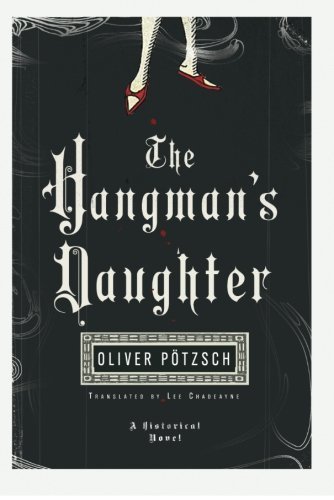
Book #9: The Hangman's Daughter
Oliver Potzsch's The Hangman's Daughter was our book club's choice for February.The book (published by Amazon Crossing, interestingly enough) is written in German, translated to English by Lee Chadeayne. It is set in 1600s Bavaria, where a young boy has been found dead. A strange mark is found on his body, leading a local midwife to be accused of witchcraft. The killing keep occurring, and Jakob Kuisl, the town's executioner, is skeptical of the witchcraft accusation. With the help of his daughter, Magdalena, and the local physician's son, Simon, the hangman is determined to find who is responsible.
As I said in the book club discussion, I have never read a book that completely left me with no clue how I felt about it, but this one did exactly that. I finished it, thought I liked it, decided I didn't, thought maybe I actually did, decided that I in fact HATED it, then decided I didn't know. What?
Maybe I was just disappointed. It all seemed reeaaallly pointless... I spent 2 weeks reading a book that led me to believe it was about one thing, and then I found out in the last couple of chapters that it wasn't about that at all. It kind of irked me. I'd be spoiling a lot by explaining myself further, but just know that the whole answer to the mystery really ticked me off.
I had some issues with the translation and characterization. (Of course, the characterization may have been due to the translation, so...) Just little things that weren't quite worded right or seemed out of place for the time period. As I have mentioned before, as a history major, I try really hard not to be super academically critical of historical fiction, or else I'd never enjoy anything. It has to be pretty glaring for me to get really worked up over, and the inaccuracies in The Hangman's Daughter weren't a big deal at all. The characters (especially Jakob and Simon) felt very nondescript in terms of their time period. My brother pointed this out as well, so I'm glad to know it wasn't just me... They had very modern ways of thinking, not in terms of being "ahead of their time," because I realize that was the point, but in terms of feeling like they could be characters in a book set in 1860 or 1980 or 3014. That may be a good thing, depending on how you look at it, and I certainly realize that Potzsch was attempting to make them seem wiser than the members of their community, but it came across a bit off.
As I write, I guess it seems like I disliked this book more than I liked it... I'm (again) not sure if that's actually the case. I liked a lot of things about the story, especially at the beginning. For the most part, it kept me interested and made me want to keep reading... But, as I've said many times before, a disappointing ending will forever ruin a book for me... Still not over the last chapter of The Lovely Bones, which I read yeaaarrrss ago.
2.5/5 stars
Read from February 1, 2011 to February 12, 2011
--C
Saturday, February 19, 2011
Book #5: Dreaming Anastasia
Question: What is my favorite, favorite, favorite historical topic?Answer: The Romanovs and the Bolshevik Revolution
Question: What is my favorite, favorite, favorite thing about that particular topic?
Answer: Anastasia Romanov and the theory that she survived her family being massacred.
Question: What is my favorite, favorite, favorite price for books?
Answer: Free
It should come as no surprise, then, that I had a minor freak-out when I ran across Dreaming Anastasia, a young adult novel by Joy Preble, for freeeee on Kindle a couple weeks ago. (Now it's around $7.00. This is why I check the Top 100 Free Kindle books every other day.)
In Dreaming Anastasia, in the present day, a typical seventeen-year-old named Anne is just going about her average teenage life when she realizes that she's being stalked by this dark, odd dude named Ethan. Then she starts having strange dreams about Grand Duchess Anastasia Romanov being trapped in some hut with a witch. Odd, since Anastasia and her entire family were killed in 1918. Then, even weirder stuff starts happening -- glowing extremities, freaky weather, getting chased by guys with weapons... Eventually, Anne learns that Ethan has come to her so they can help save Anastasia Romanov from a witch popular in Russian folklore. The book shifts between being narrated by Anne, Ethan, and Anastasia herself, who is writing in a journal from captivity.
The Romanovs have always appealed to me... Probably because, although flawed in several ways, they are such a beautiful family and their story is so tragic. For those of you not familiar with their story, it will be my pleasure to give it to you simply and briefly: Czar Nicholas II, of the Romanov dynasty, was the ruler of Russia for a while. He had a lovely wife Alexandra, four daughters (Olga, Maria, Tatiana, and Anastasia) as well as a young son (Alexi) who had
hemophilia. Alexi was sick a lot, and a crazy lunatic named Gregory Rasputin managed to weasel his way in to having some degree of power with the royal family because he claimed he had powers that could heal Alexi. Things went rather sour, and eventually Nicholas II was overthrown by the Bolsheviks in the early 1900s. The family was held captive for a while by the Bolsheviks, and eventually they were taken into a basement and killed. Their bodies were burned and buried. Upon excavating the bodies, they never found the remains of Anastasia. So, there are a lot of rumors that she somehow survived or was rescued and lived the rest of her life with a secret identity. There have been a few people who have claimed to be Anastasia, most famously, Anna Anderson, who was later revealed to be lying thanks to DNA.So. Joy Preble takes this story to a whole new level by adding a few twists... Some family drama, some paranormal activity, some Russian fairy tales. I'm down with it. I'm down with anything Romanov-related. Preble is a high school English teacher (!!!! awesome), and this is her first novel.
I really, really enjoyed this, although I think I can admit that it's definitely not something everyone would enjoy. (I think the intended audience would enjoy it, since it's a young adult book, but I wouldn't recommend it to serious history buffs or probably anyone Russian.) I am definitely biased since I love the topic so much, but everything else about the book was great, too. I really liked Anne most of the time (although she was a little too "Bella Swan"-esque sometimes), and Preble has a very sarcastic tone sometimes that I really enjoyed. Anne's family background and her best friend Tess were great aspects of the story, too. Switching narrators kept things interesting, especially since Ethan and Anne both occasionally pick up on things that the other doesn't.
I would advise history experts o
r Russian enthusiasts from reading this book because I will admit the historical parts are very basic. The references to Russian culture are pretty obviously American-minded (I mean, what do we know about Russia other than Tolstoy and Fabrege eggs?), and sometimes Anastasia's "journal" entries just sound like a textbook excerpt about the Romanovs -- but! I don't have a problem with that as much as some fancy-pants folks on Amazon apparently do because it. is. a. young. adult. book. It's OK if it's not mind-blowingly enlightening as far as Romanov history is concerned. I'm just glad someone wrote an interesting, entertaining book about Anastasia Romanov so that some teenager somewhere might remember who she is one day, because they probably aren't going to remember it from history class....Which brings me to my next point -- My favorite part of the whole book is probably this quote from Anne:
"Normally, world history is not a subject that makes me do back handsprings. Not that I don't like knowing about that stuff. I actually do. But Coach Wicker -- who pretends to teach the class when he's not too busy figuring out football plays on the computer -- is the most singularly boring person I've ever met."
Or maybe it was this (also Anne):
"Why the administration would allow someone to teach honors world history who mispronounces Bogota and can't find Tierra del Fuego on a map because he thinks it's in Peru is a mystery to me."
I will avoid going into further detail there, but let me just say that I totally get those quotes. And I have a feeling Preble being a teacher has a lot to do with why she gets those quotes. I wish her the utmost success and I hope she writes more soon.
Anyway, this book is well worth the $7 it now costs on Kindle, and I would suggest you give it a read. I would also remind you to peruse the free Kindle books quite often, as I have found many a gem.
4/5 stars
Read from February 17, 2011 to February 19, 2001
--C
Labels:
dreaming anastasia,
free,
historical fiction,
history,
joy preble,
Kindle,
Russia,
young adult
Wednesday, October 6, 2010
Book #26 -- Billy Boyle: A World War II Mystery
A historical fiction Kindle freebie! Yes! This book is the first of a series, and undoubtedly this is offered for free on the Kindle so that you feel compelled to buy all of the other ones after you read it.In Billy Boyle: A World War II Mystery by James R. Benn, Boston cop Billy Boyle finds himself drafted into the army in the middle of World War II. His uncle is some dude named Dwight Eisenhower (heard of him? I haven't), so he manages to land a desk job instead of being sent to the front lines of battle. He goes to London and is stationed at the Norwegian headquarters there. He quickly learns that there is a German spy somewhere within the Norwegian headquarters. Soon enough, there's a murder to solve. Even though he's naive and unprepared, Billy has to put his police training to work to help the U.S. Army in the middle of World War II.
I enjoyed this book, but I'm not sure everyone would. Toward the beginning, there's a lot of political/military talk that I can take with the bat of an eye after five years of history courses, but it might be a bit confusing to someone who's not interested in history. Some of the background information kind of seemed like they were written like a textbook instead of a story.
Billy isn't the strongest of characters to carry an entire series, if you ask me. He's rather "aw, shucks" and "dang, this crap is hard," which I guess is supposed to make him relatable and endearing, but I have no patience for... um, anything, so he kind of just got on my nerves. There's enough going on that it didn't ruin the book for me at all, but unless he toughens up a little, I'm not sure I could handle him as the protagonist for a whole series.
This is one of those rare books where the sub-plots were more interesting to me than the main plot. The whole spy-murder-conspiracy business was intriguing until they started figuring it out, and then I was just like, "... OK." For a book set in the middle of a war with so many opportunities to include some crazy, twisted, mind-blowing vigilante stuff, I felt like the route Benn took with the plot was lacking. Especially the ending.
If I stumble across these books in the future, I may pick them up... And who knows, I may get a wild hair for some World War II fiction one day and actively seek out another book in this series. For now, I'm going to say this was a decent piece of historical fiction and move on to the much-anticipated Mockingjay.
2.5/5 Stars
Read from September 23, 2010 to October 4, 2010
-- C
Friday, September 24, 2010
Book #25 -- The King's Nun
As a historian of sorts (a degree in history and social science education counts as being a historian, right?), I was drawn to this book because of its historical theme… Oh, yeah, and also because it was in the big box of $1 books at Books-A-Million. Admittedly, I knew as soon as I read the description on the back that it very well could have been a cheesy, terrible romance-esque novel, but I’m proud to say that it wasn’t. My $1 and I are pleased.Catherine Monroe's The King's Nun is about a young soon-to-be nun named Amelia who is chosen by her abbess to lead King Charlemagne on a tour of their monetary when he comes to visit. The monetary is in need of some financial aide, and Amelia’s job is to convince the king to give them some dough. When King Charlemagne arrives, Amelia realizes that she’s met him before, only she didn‘t know he was the king back then. Juicy, right?
King Charlemagne is impressed with Amelia’s intelligence, and soon he sends for her to come to the palace to advise him on some family issues. She’s not too thrilled about it, but she and the king become very close over the course of her stay at the palace. Not close like that, you gutter-minded animals, but, you know, emotionally close. Sort of. But eventually the king has to go to war with those dirty Saxons, and Amelia goes on with her life. I’d say the vast majority of the novel doesn’t even taken place with Amelia and Charlemagne in the same place.
Anyway, this easily could’ve taken a turn for the trashy side, but it really didn’t. There are no gratuitous sexual scenes, no mention of “loins,” and no trite happily-ever-after ending. I like that. Because of the subject matter, it kind of reminded me of The Pillars of the Earth by Ken Follett, which is hands-down my favorite book ever. Monasteries and royals and history and all that.
I feel like I should mention one tiny thing that bothered me, even though I know I’m a total snob and this wouldn’t bother most normal people. The chapters go back and forth between Amelia’s point of view and Charlemagne’s point of view, which is totally fine. The problem is that Amelia’s chapters are written in the first person and Charlemagne’s are written in the third person limited. Why does that bother me? I don’t have a clue, but it did. I’m cool with bouncing to different view points (in fact, I think most of my favorite books do that), but aaarrgghhh, keep it in the same person.
All in all, it was a quick, entertaining little story, and I think it was well worth my time. I dare say it might have even been worth more than I paid for it.
3 out of 5 stars
Read from September 14, 2010 to September 22, 2010
--C
Labels:
catherine monroe,
historical fiction,
the king's nun
Saturday, February 13, 2010
Pirate Latitudes (1)
Let me preface this by saying that I'm a huge Michael Crichton fan. My bookshelf is crowded with Crichton books, and I count Jurassic Park and Timeline among some of my favorite books. I may be a bit biased. I won't say that Pirate Latitudes is a great book, but I will say that it was OK.
Now, if you're like me and have read Crichton's other works, you'll be surprised at the lack of science and intrigue. The novel is set in the Spanish controlled Caribbean during the 1600s, and follows the exploits of a British colony and it's menagerie of rogues. The reader is first introduced to the governor of the Jamaica colony, Sir James Almont, who plays a large role near the beginning of the book. He's is not much of a redeeming character, and the first few chapters of the book drag as a result.
Soon, though, the reader is introduced to Captain Charles Hunter, who is the protagonist throughout the remainder of the book. The reader is then taken on a roller coaster ride as he/she follows the exploits of Hunter and his crew as they attempt to invade a Spanish fort, capture a Spanish galleon, and exact revenge.
It isn't until the reader nears the end of the book that it becomes apparent that the book was published posthumously. Several of the events near the end seem a bit rushed, and many of the conflicts reach an abrupt resolution. Fans of Crichton's scientific thrillers might not feel at home with this novel, but readers will be able to recognize and appreciate his writing style. Even if they're not usually fans of Crichton, historical fiction fans may find Pirate Latitudes to be a good read.
All said, if you find the hardcover in a bargain bin or run across a good deal on a paperback, it's worth a read.
--D
--D
3/5 Stars
Subscribe to:
Posts (Atom)