Welcome!

We started this blog in 2010 after a New Years' Resolution to read 60 books between the two of us. (40 for C, 20 for D.) After reaching our goal, we decided to keep going in 2011. This year, C has pledged to read 30 books, and D will read 12. By no means are we professional reviewers; we're not even professional bloggers. We're just two people who love to read and decided to share our thoughts and offer our limited insights. We hope you enjoy!

Wednesday, December 29, 2010

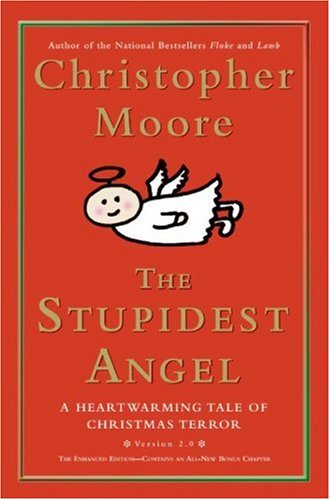
The Stupidest Angel: A Heartwarming Tale of Christmas Terror (20)

Yes, another Christopher Moore book.  What can I say?  I'm hooked.  Plus, it fit the season.  The Stupidest Angel: A Heartwarming Tale of Christmas Terror is perfectly fun romp through Moore's recurring town of Pine Cove during the Christmas season.

Many settings, characters, and motifs from Moore's earlier books make an appearance here:

  • Raziel - Lamb: The Gospel According to Biff, Christ's Childhood Pal
  • Theophilus Crowe, Molly Michon, Gabe Fenton, and Valerie Riordan - The Lust Lizard of Melancholy Cove
  • Robert Masterson, Jenny Masterson, and Mavis Sand - Practical Demonkeeping and The Lust Lizard of Melancholy Cove
  • Tucker Case and Roberto the Fruit Bat - Island of the Sequined Love Nun

Those familiar with Moore's writings will also find slight allusions to some of his other works, like the French irreverence from Fool, the Rastafarian speak from Fluke, and Raziel's affinity for Spider-Man from Lamb.

The story begins with the accidental murder of a Santa-suit-clad jerk that takes place days before Christmas.  Of course, it iswitnessed by a twelve-year-old boy on his way home from a friend's house, and of course that boy prays for a resurrected Santa so that Christmas can be saved.  The problem is that Raziel has to perform this Christmas miracle because of a lost angelic bet, and Raziel doesn't have the brightest of heavenly glows.  He brings the faux-Santa back to life as a zombie (and the rest of the Pine Cove graveyard with him) on the night of the Lonesome Christmas party, and chaos ensues.

This book, like every other Christopher Moore book I've read, was hilarious.  From the pot-smoking constable to the pilot with a giant talking fruit bat to the bar owner with her affinity for burros with wiffle ball bats, the characters teeter on the edge of the ridiculous, and the plot is one absurd twist after another.  This is a must-read for Moore fans or just someone who wants a riot of a Christmas story.  If you do pick this up, definitely pick up the version 2.0 of the book (pictured), which includes a follow-up chapter with a Lonesome Christmas party tale for the following year.  Christmas will never be the same.

5/5 Stars
--D
~FIN~

Book #40: House of Dark Shadows

Well, I certainly ended the year on a good note.

House of Dark Shadows by Robert Liparulo is the first book in the Dreamhouse Kings series. The King family -- Xander, David, Toria, and their parents -- pick up and move from Pasadena to boring, rural Pinedale, California. The kids (especially Xander) aren't very excited about it, and living in a motel isn't helping the situation. Soon enough, Xander's parents fall in love with a giant, old fixer-upper house in the middle of the woods. Xander is immediately creeped out by the house, but his family just thinks he's paranoid. Soon enough, the entire family is staring to have second thoughts, what with all the creepy sounds, giant footprints left in the dust, and shadows lurking all over the house. Things get even weirder when Xander and David discover a passageway that leads to a hidden wing of the house, which holds passageways of its own... to different time periods.

I completely loved this book. It's safe to say I'll be reading every book in this series as soon as I can get my hands on them. From about ages 7-11, I was totally obsessed with R.L. Stine's Goosebumps books. I read every one that they carried at Bookland. (They still had Booklands back then. In Cullman, Goosebumps were on the back wall, bottom two shelves. Trust me.) I kept my 10 favorites stacked neatly in the right corner of my classroom desk. This book took me back to those days. It's obviously written for an older audience, but still. I totally felt like 3rd-grade me, all excited and creeped out.

I can't say anything bad about this book, except that the ending is totally not an ending. That's probably why instead of saying "The End," it says "NOT the End." At least he's honest. I wish I had the next one sitting here waiting on me. I'd never heard of this series, which is surprising since it seems to have been out for a while. I'm excited to read it, since there's a pretty hefty historical aspect involved. The portals in the houses are just dripping with history lessons. You don't get in to that much in the first book, but I can feel it. It's coming.

READ THIS!

5/5 Stars

Read from December 26, 2010 to December 29, 2010

--C

Sunday, December 26, 2010

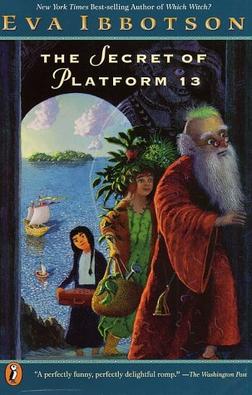
Book #39: The Secret of Platform 13

This is my second Eva Ibbotson book of the year. The first was The Star of Kazan, which I liked although I found the pacing a bit off. I found this book, The Secret of Platform 13, in a double-book special at my favorite used bookstore; it also includes Ibbotson's book Island of the Aunts. I decided to give it a try since I enjoyed the plot of Kazan so much. I'm happy to report that the pacing problem isn't an issue in this book.

The Secret of Platform 13 is about a mystical secret land called "The Island," which has creatures such as mermaids, hags, harpies, mistmakers, ogres, and wizards. The Island can be reached through Platform 13 in England. You can only pass between the two realms for the period of exactly nine days, which comes only once every nine years. When the story opens, the platform is open, and the infant prince of the Island is taken through the opening by his nannies who want to visit England. The prince is stolen by a snobby, vapid debutante who longs for a baby of her own. When the nine-day opening is over, the nannies have to return to the Island to report to the King and Queen that their son has been stolen and cannot be retrieved for at least the next nine years. The novel picks up again nine years later when the platform opens again, and a group of "rescuers" have been chosen to go through the opening to bring home the prince, who has lived his whole life having no idea he is a member of the royalty in a land he doesn't even know exists.

This is a great little story with wonderfully painted characters and a great setting. Judging from the two books I've read, Ibbotson is a master at creating whimsical atmospheres for her stories. Definitely perfect for kids, but completely enjoyable for adults, as well. As a half-way intelligent 23-year-old, I will admit that I figured out the plot twist by about the fifth chapter, but it really didn't take away from the story for me. I knew what was coming at the end, but I still thoroughly enjoyed the rest of the book. It's a great combination of reality and fantasy, since parts of the story take place in both worlds. There's a sense of familiarity when the "normal" people of England are discussed, but as soon as the book switches to the adventures of the rescuers and all of their powers and spells, you're immediately sucked into a great fantasy world.

I will say, though, that there are some striking similarities between this book and The Star of Kazan. Both involve infants being raised by people who are not their parents, and thus people not being who they say they are. Both involve an elaborate rescue plot. Both, for some reason, involve musical instruments playing a major role in the rescue mission (which I think is a completely random thing to have in common). There are a lot more, but I don't want to ruin any of the book. It was weird, but I suppose a lot of childrens' writers find a formula that works and they stick to it. I'm OK with it, but I did think some of them were a little eerie.

Slight sidenote: There are a ton of people reviewing this on Amazon calling this book a Harry Potter wanna-be, and an equal number of people screaming about how this book was written way before Harry Potter. The latter is definitely a valid point. Not having read the first word of a Harry Potter book, I'm not at liberty to say what their similarities are, but I do know the basic premise of Harry Potter, and I have to say, I don't really see any reason for the comparison. But just in case you're thinking the same thing, it is important to know that this was written pre-Potter explosion. Just throwing that out there.

I would certainly recommend this to a reader of any age, and I would encourage you to put Eva Ibbotson on your list of authors to look for when you're perusing the bookstore.

4/5 Stars

Read from December 22, 2010 to December 26, 2010

--C
Book #38: Stupid Christmas

The combination of "holiday," "Kindle," and "free" sucked me in to this, and I will never, ever forgive myself for it.

The "author" (I think "editor" is more appropriate), Leland Gregory has scoured... some sources?... to find real-life zany Christmas-related stories and placed them into this collection. Sounds fun, right? It's not. There are a lot of problems, here.

First of all, there are no sources. I was a student of history. I live for sources and citations and footnotes. It's just how I roll. When you try to tell me something happened, especially if that something is hard to believe, you better be able to prove it. This entire point of this book is to collect outrageous incidents. There's a lot in this book that's hard to believe. It all supposedly actually happened, yet here's no reason for me to believe that it did. I mean, I'm not saying Gregory completely leaves out any trace of a source, because a lot of times he'll throw in "According to [insert random newspaper title here]"... But come on, you're writing and publishing a book. And getting paid for it. Make the effort to throw in an issue number and a date and some way for me to find what you're talking about. Geez. FYI, his book Stupid American History (which has the same basic purpose as this book, except it's about American History) is also free on Kindle right now. From what I understand in the reviews, he doesn't cite any of that either. SERIOUSLY, a history book with no citations?!?!??! OH MY GOD. That might just be the history jerk in me, but it really bugged me, and this is my review, so there.

Second, there are a disturbing number of "stories" in this book that have very little to do with Christmas. Sometimes it's just stuff that happened in December. December events are not equal to Christmas events.

Third, the incidents in the book aren't even interesting. I mean, yes, people are stupid and it's fun to read about the dumb things people do, but most of what was in here was just useless. There are probably close to 100 little tales in here, and only four or five were interesting enough for me to even remember. The one that sticks out the most for me was a Wal-Mart who set up a large Toys for Tots charity donation box near the exit of the store (so that customers could purchase a toy, then drop it off as a donation on their way out). When the Toys for Tots representative came to pick up the box, it was empty because the Wal-Mart manager told his employees to reshelf all merchandise unless there was a receipt with it to prove it hadn't been stolen and then donated. That's not actually funny, but it is stupid. And horrible. But honestly, there are only a few good ones in here. Most of them are just about drunk people doing dumb things and being arrested for it, so I suggest just picking up your local paper if you want to read about that.

I guess I was hoping for a nice collection of Christmas factoids and strange holiday traditions, like maybe where all those verses in "The Twelve Days of Christmas" come from. (Obviously not in the book, and I just realized I'd like to know more about it. I think I'll look that up.) I absolutely got what I paid for here, so I totally deserved it... but I invested several hours in reading this tripe.

Let's end this on a positive note: Each incident was only a couple paragraphs long, so it was great to read when I had a few minutes at a time to spare. I read it intermittently at the same time I was reading my last few books. That was nice. I guess.

Read from December 10, 2010 to December 25, 2010

1/5 Stars

--C

Book #37: The Christmas Journey

Donna VanLiere decided that the version of the birth of Christ in the Bible wasn't good enough, so she rewrote it.

OK, that sounds crass. Really, though, The Christmas Journey is VanLiere's attempt at putting more emotion into the Christmas story. As she explains in the introduction, the scriptures are rather concise. They don't mention the conversations Mary and Joseph had or the labor pains or the stench of the stable. VanLiere adds all of this to her version.

I'm not going to summarize the plot, since you should really know this story unless you have legitimately been living under a rock.

This reminded me of Anita Diamant's The Red Tent for obvious reasons -- it takes a few nondescript Bible verses and elaborates. This is much shorter, coming in at 96 pages. (The beginning of the book is the actual scripture from Luke.) VanLiere's version of the Christmas story was a bit more humanized, and she was successful in adding some emotion and description into the story. I don't think it was enough, though. I would've liked to read something a lot more like what I read in The Red Tent... I wanted a full story, with background information on Mary and Joseph and dialogue and maybe some embellishments... Although, I'm sure the reason there weren't more embellishments is VanLiere's hesitation to add untruths to a story that most of the world is very, very familiar with. Whereas Dinah -- the center of The Red Tent -- is a lesser known Biblical figure, I'm pretty sure most people who know about the Bible are familiar with Mary and Joseph and that Jesus fellow. I guess you don't want to step on many toes there, and The Red Tent was clearly pushed as a fiction book. The Christmas Journey isn't so much.

Anyway, it's very simply written, and it's a nice, quick read for Christmas Eve night. The intro mentioned that VanLiere originally wrote this as a narrative to read during a church service (I think it's rather long for a church service reading, but maybe she's a Baptist). My thing is that I don't see the need to bother adding "emotion" and description to a story if you're not going to just take it and run with it. I'm sure there are a lot of people who'd love this slightly more human version of the birth of Christ, but it didn't do a whole lot for me.

2/5 Stars

Read on December 24, 2010

--C

Wednesday, December 22, 2010

It's Beginning to Look a Lot Like Zombies: A Book of Zombie Christmas Carols (19)

I decided a while back that my last book of the year would be Christopher Moore's The Stupidest Angel: A Heartwarming Tale of Christmas Terror (more on that in my next review).  As you know, my last book was The New Dead a collection of zombie-related short stories.  What better to segue between the two than a book of zombie Christmas carols (with an introduction by Christopher Moore!).

This is just a small, simple book where the author has taken the liberty of assuming the the Zombiepocalypse has happened, and that all of the traditional Christmas songs have been rewritten accordingly.  With songs like "I Saw Mommy Chewing Santa Claus," "Have Yourself a Medulla Oblongata," and "Deck the Halls with Parts of Wally," this book is a hilarious new take on those classic songs from your childhood.

The best part of this book, though, may be the drawings that pepper the pages between carols illustrated by Jeff Weigel.  Imagine a giant zombie reindeer with a glowing nose or a zombie boy unwrapping a present as a zombie puppy licks his face.  I wish I could show you some of these pictures, but I'm entirely frightened by zombie copyright lawyers, so here's a link to a Google search that includes a few.

This book was tons of fun for me, but if you're a traditionalist who looks for reasons to get offended, skip it.

4/5 Stars
--D

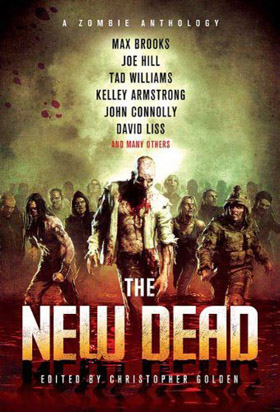
The New Dead (18)

The New Dead is a collection of zombie stories (save a few that, for some reason, made the book while having nothing to do with the living dead) edited by Christopher Golden.  I'll be honest--I picked up this book in part because I'm a big Max Brooks fan, and Golden included one of his World War Z tales in the collection.  Still, I do like stories about the undead.

This collection left me with mixed feelings.  Some of the stories were really good.
1. "Lazarus" by John Connolly, the story of the "original" zombie.
2. "What Maisie Knew" by David Liss, an interesting take on zombie tales where zombies are bought, sold, and used much like Rosie from the Jetsons.
3. "Copper" by Stephen R. Bissette, the story of a group of ex-soldiers trying to survive.
4. "Life Sentence" by Kelley Armstrong, where a man in search of immortality turns to undead research.
5. "Family business" by Jonathan Maberry, where a young man follows his brother on the quest of a zombie bounty hunter and discovers things about himself and his family along the way (my second favorite story in the collection)
6. "Second Wind" by Mike Carey, where a re-animated stock broker builds himself a neo-homestead and discovers a new dynamic of zombie-human interaction.
7. "Closure, Limited" by Max Brooks, a tale of psychological rebuilding in a post zombie world.
8. "The Storm Door" by Tad Williams, my favorite of the collection, about an occult specialist who discovers a dark secret.
9. "Twittering from The Circus of the Dead" by Joe Hill, a story written through the eyes of a Twitter-using teen girl in the midst of a zombie filled circus.

Others weren't so great, including one that didn't have anything to do with zombies. What?  Really?  A collection of short stories about zombies that includes a short story that's NOT ABOUT ZOMBIES?  I don't get it.

Still, this was a good collection over all.  If you're into zombie fiction and looking for a book that you can read in segments (which is my favorite thing about short story collections), this is a great choice.

3.5/5 Stars
--D