Confession: Toward the end of last year, I started to regard writing book reviews as more of a chore than something I really enjoyed doing. I'm not sure why, but it just seemed like one more thing on my never-ending To-Do list. Rather than force myself to continue doing it, I decided I would just back off for a while. Who knows? -- I might decide I miss it in a few weeks and start back up. That being said, I still want to keep up with the books I read and let others know what I'm reading. So, for the time being, I'll just be posting the titles of the books I read (with a link to the book on Amazon so you can learn more about it with minimal effort), the author, genre, and a 0-5 star review. I'll probably do this monthly. If I come across a book I really want to review, I'll jump back on the wagon and write one.
Of course, if you want to know more about my thoughts on any of the books I read, feel free to leave a comment or send me an email: rowbseat13@gmail.com. (Before you ask, "Row B, Seat 13" is a lovely song by my favorite band of all time, Jump, Little Children.)
January 2012
1. Harry Potter and the Half-Blood Prince by J.K. Rowling (Young Adult)
5 out of 5 Stars
2. Harry Potter and the Deathly Hallows by J.K. Rowling (Young Adult)
3,894,892,038,409,328 out of 5 Stars
3. The Girl Who Couldn't Say No by Tracy Engelbrecht (Memoir)
3 out of 5 Stars
February 2012 (So Far)
4. The Long Run (Kindle Single) by Mishka Shubaly (Memoir)
3 out of 5 Stars
5. Eleven Twenty-Three by Jason Hornsby (Science Fiction)
3 out of 5 Stars
Monday, February 13, 2012


Sunday, January 1, 2012
Special Post: Another Year Over
Well, we have seen another ball drop here at the old blog. Let's recap what happened this time last year:
- We changed the name of the blog to Descripted, due to the fact that "Sixty Books" wasn't really accurate anymore.
- We started a monthly Descripted Book Club via Google Groups.
- I (Chassi) resolved to read thirty books in 2011, while Derrick made the gutsy resolution to read a whopping twelve -- one for each month of the book club.
Now, let's see how that stacks up:
- We're sticking with Descripted. Not that it matters. Raise your hand if you care... Didn't think so.
- The book club lasted for about four months, although I don't think we ever had a single month where every member read the book and participated in, you know, actually discussing it. I gained the nickname "Book Club Nazi" because I was constantly reminding people to nominate, vote on, and post about books. I tried. I really did. Unfortunately, the club was comprised of real adults with real lives. Truth be told, even if the book club had kept on truckin' after the summer, I probably would've dropped the ball around August because things got crazy at work, with school starting back (job #1) and football season rolling in (job #2). It was a pleasant idea, and I wish we had all had more time to devote to it. I read books I never would have read without the book club (Life by Keith Richards, American Gods by Neil Gaiman) and... kind of... enjoyed them. Sort of. Who knows, maybe we'll try it again sometime when we're all a bit more settled, or perhaps we should give longer time periods... Or maybe I just shouldn't be such an anal-retentive jerk about it. We'll see.
- I read thirty-four books, because I'm an over-achiever like that, and Derrick probably read abboouuuttt... .three, unless you count comic books or text books about educational leadership. (But let's give him some credit -- he is a mere internship away from completing his Master's Degree in May!)
As for my goals for 2012, I think 30 is a good number of books to read in a year. I had plenty of time, I read a variety of things, and I didn't feel rushed or tempted to opt for a short, easy book just to help myself meet a deadline. So... 30 more in 2012!
Here's to reading a book that'll change your life this year. Cheers!
--C
Book #34 -- Water for Elephants
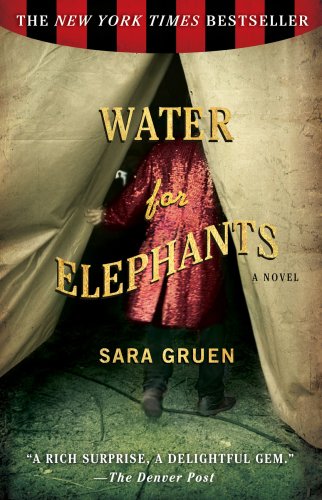
Sarah Gruen's Water for Elephants has been immensely popular since is publication nearly six years ago. I'm not sure why I ignored it for so long, but earlier this year, when it was turned into a movie (starring none other than Twilight's Robert Pattinson -- gag), I definitely know why I continued to ignore it. Just didn't seem like my cup of tea.
I recently found out that because I'm an Amazon Prime member, I can take advantage of the new Kindle Owner's Lending Library and "borrow" some select titles for free. I was browsing through the titles, and this one was the first one I came across that I recognized. I clicked to borrow it, mostly just to see how the whole lending thing worked. I had access to it for ten days, so I thought, "Why not give it a try?" So. Glad. I did.
The story is about Jacob Jankowski, a young student in veterinary school during the Depression. After a family tragedy that forces him to miss his final exams at school, Jacob takes off and jumps a train to try to escape his shambled life. He finds himself on board with the Benzini Brothers' Most Spectacular Show On Earth. At first, the shady circus workers he encounters on the train car are threatening -- in the days of the Depression, circuses were suffering, and free-loaders looking for work weren't welcome. When they find out that Jacob has a background as a vet, they realize his talent could come in handy with the show's exotic animals. Jacob land himself a job travelling with the show and soon learns about the strange (and often horrifying) things that go on behind the scenes of a train-circus in the 1930's. He also finds himself falling for Marlena, the beauty that performs with Liberty Horses as one of the show's biggest highlights. She also happens to be married to one of the easily-angered circus bosses. As more and more circuses around the country are closing due to the economy, things get heated, and eventually the Benzini Brothers' train takes a turn for the worst.
This is such a beautiful book. Gruen is a genius, and she absolutely did her research. One of my favorite parts of this book was reading an interview with the author at the end where she talks about how deeply she delved into circus archives from the era and describing that many of the events that take place in the novel -- the ones that are either so strange or so gut-wrenchingly horrid that you can't believe they're true -- actually did happen on train circuses in America. That really adds a lot to the emotion of the book, and I kind of wish I had known it before I read it.
The novel alternates between chapters told from Jacob's perspective while he was on the circus train, and chapters told from Jacob's perspective as a 90-something-year-old man in a nursing home. It's really just... awesome. I want to say so much, but I want you to read it so you find out for yourself.
And I suppose I'll watch the movie soon. Robert Pattinson (and Reese Witherspoon, too... bleh!) make me a bit nervous, but I found out that one of the deliciously evil characters is played by Christoph Waltz, who plays one of my favorite villains ever in Inglourious Basterds, so that alone is enough for me. We'll see how it holds up.
Read from December 22, 2011 to December 30, 2011.
5/5 Stars
--C
Book #33 -- Atonement
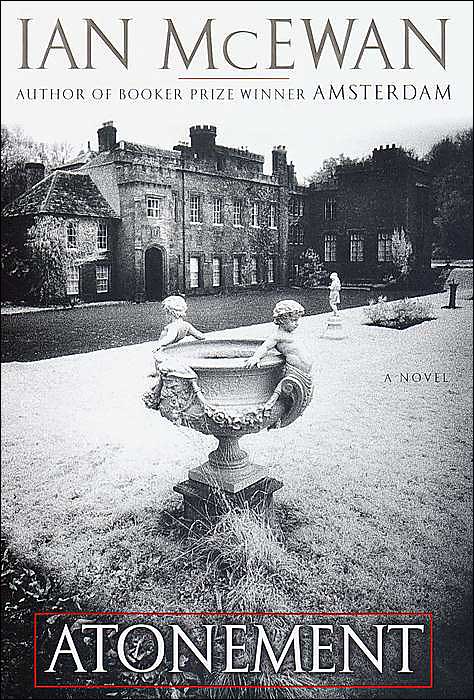
Ian McEwan's Atonement is a much-celebrated novel that was made into an even-more-celebrated film in 2007. I knew of the film, due to its wide critical acclaim in the award season following its release, but had not seen it before reading the book.
The book begins in pre-World War II England and is centered around the well-to-do Tallis family. There's the always absent workaholic father whose name I don't even remember, and Emily, the mother who is such a poor motherly figure that her children call her by her first name. There are three Tallis children -- Leon, Cecilia, and Briony. Briony is a brilliantly talented writer, even at the young age of twelve, with a very active imagination. So, when she "accidentally" witnesses a couple of awkward, flirtatious situations between her sister, Ceclia, and Robbie Turner (the son of the Tallis family's live-in help), Briony lets her imagination twist the situation into something that it isn't. Later in the novel, a young cousin of the Tallis' is raped. Briony's mind is so skewed that she aides the police investigation with some false information. Obviously, false accusations can easily ruin lives... So the rest of the book is about Briony dealing with her own guilt and seeking atonement (see what they did there?) from those she has wronged.
I should also add that there is a layer of (what appears to be) self-critiquing in this novel by McEwan himself. He uses Briony's writing to discuss the struggles of authors and the guilt associated with "playing God" and determining your characters' fates... Blah, blah, I don't really like all that abstract, introspective crap, so I'm not going to discuss it in the review, although I thought I should mention it so that no one thinks I'm an idiot who just didn't notice it. I did; I just don't care.
Let me start by saying that I think McEwan is a terrific writer. Really, he's got beautiful phrasing, and he's very good at playing out emotions. The novel itself lagged in a few places, but overall, the pace was good. I enjoyed reading the novel, but I did not enjoy the actual novel itself. That doesn't seem like it makes sense, but, as I have said many times -- the ending of a novel will make or break it. In this case, it wasn't really just the ending, but... maybe the lack of an ending? I mean, it ended, but it was utterly pointless. I kept waiting on some giant secret revelation that was going to crack the whole book wide open, but it never came. The latter parts of the novel cover about ten years, and I thought surely something was going to come of all those words on all those pages, but... No. Maybe I'm completely crazy, because there are tons of people who rave about this book, but I felt like I wasted my time. I realize that all books don't have to have a happy ending where all the lose ends are tied -- in fact, I prefer books that aren't like that -- but this one just didn't work for me.
Now...
I'm about to say something I do not ever, ever, ever say, and I will probably never say it again, so prepare yourselves.
Are you ready?
OK.
The movie is so, so much better than the book.
..............Bleh, that leaves a terrible taste in my mouth. But it's true. The film stays very, very close to the plot of the book with only a few minor changes, so it doesn't make up for anything that's wrong with the book. Same plot, same ending, same everything. But somehow, it is a beautiful movie. That's so strange to me, but it's true. Joe Wright, the director, must be some sort of cinematic genius. I have never seen a movie directed so well. I don't want to turn this into a movie review but I do want to say this:
One of my biggest issues with books-turned-to-movies is that you often lose the sense of perspective that you get from being inside different characters heads. Atonement brilliantly worked around this by using a specific cue (e.g. a close-up of a doorknob turning) to signal the beginning of an important event (e.g. the first time Briony witnesses Robbie and Ceclia's flirtation). You watch it from Briony's perspective. Then the movie returns to that same cue and goes through the event from Ceclia's perspective. It's not that clean-cut, but you get the idea. Really well done. For once in my life, I am telling you to watch a movie but skip the book. I must be going crazy.
Read from November 28, 2011 to December 21, 2011
2/5 Stars
--C
Sunday, December 11, 2011
Book #32 -- Little Bee

You see, the thing about Chris Cleave's Little Bee is that you're not supposed to tell anyone what it's about. Even the description on the back of the book is lacking:
"We don't want to tell you what happens in this book. It is a truly special story and we don't want to spoil it. Nevertheless, you need to know enough to buy it, so we will just say this: This is the story of two women. Their lives collide one fateful day, and one of them has to make a terrible choice, the kind of choice we hope you never have to face. Two years later, they meet again -- the story starts there. Once you have read it, you'll want to tell your friends about it. When you do, please don't tell them what happens. The magic is how the story unfolds."
I'm... not... really sure why they don't want people to say what happens, because A) I don't think it would ruin anything if I were to explain the basic plot of the book, and B) I think knowing the basic plot would make people want to read it more... But whatever. I don't want to get shunned by the Little Bee fan community (if that even exists), so I'll just be really brief, OK?
- Little Bee -- that's a person. She's a Nigerian refugee in England who's been in a refugee holding facility since she arrived in the UK.
- Sarah is an English woman who met Little Bee on a vacation in Nigeria. (Who goes on vacation in Nigeria? Weird.)
- Sarah and her family are the only people Little Bee knows in England. So she's trying to find them.
There you go. That's what it's about. Well, that, and sadness. This book is depressing. Do not say I didn't warn you of that. Even when it's funny, it's ironically funny... like, "I-have-to-laugh-at-the-way-the-world-is-so-that-I-don't-cry"-funny. Which isn't really funny at all. I'm not saying it wasn't good, because it was actually brilliant, and extremely well-written. I think Chris Cleave is on genius-level, and I need to read everything else he's ever written immediately. It's just... sad. It reminded me a lot of Let the Great World Spin by Colum McCann (which I reviewed in March of 2010). McCann is a brilliant writer, although depressing. Cleaves is the same way. There's something sickening about the way he portrays modern first-world society through the eyes of a teenaged Nigerian girl who has fled from everything she has ever known. At times, I couldn't decide if I agreed wholeheartedly with the point he was trying to make, or if it ticked me off that he was acting like we (as citizens of developing countries) should somehow be ashamed of how our lives have evolved. I'm still on the fence about that, actually.
There's a popular thing on various social networking sites these days know as "First World Problems" -- people post a Facebook status or a Twitter update or something similar with some inane issue they're having that could only occur to someone living a comfortable life in a modern society. It's become sort of an Internet-wide joke, but it really speaks volumes. I actually found myself saying this to Derrick recently: "Our refrigerator isn't big enough." I immediately caught myself and realized how completely ridiculous that statement was and joked that it was the perfect example of a "First World Problem." But seriously, how stupid is that? Our huge electric cooling system that holds our food to keep it from spoiling is not large enough to contain all of the processed food, available anywhere in abundant quantities, which we have purchased from multi-million dollar companies. Ummmmm, ridiculous.
I came across this passage and immediately read it again. Then I got up, got a pen, underlined it, and put a sticky note on the page. It's a quote from Little Bee (the character):
"Imagine how tired I would become, telling my story to the girls from back home. This is the real reason why no one tells us Africans anything. It is not because anyone wants to keep my continent in ignorance. It is because nobody has the time to sit down and explain the first world from first principles. Or maybe you would like to, but you can't. Your culture has become sophisticated, like a computer, or a drug that you take for a headache. You can use it, but you cannot explain how it works. Certainly not to girls who stack up their firewood against the side of their house [...] This story is for sophisticated people, like you."
That really hit me for some reason. It's true. You couldn't even explain the most normal, everyday tasks to someone struggling in a third-world country. It would be absolutely alien. They wouldn't even know what to say or think if I told them my refrigerator was too small. It really makes you think about the things you take for granted. At the same time, I often got the feeling in this book that Cleaves was suggesting that, if you are fortunate enough to live in such a society, you are somehow guilty of suppressing others who are less fortunate. I don't really agree with that, but it's a pretty complex subject to figure out.
Anyway, I've just completely gone off the deep end with this. Maybe that's why they tell you not to talk about it.
5/5 Stars
Read from November 25, 2011 to November 27, 2011
--C
Book #31 -- Scary Mary

In S.A. Hunter's young adult novel Scary Mary, Mary is a misunderstood, bullied high school teenager. Her grandmother (and guardian) is the local psychic, and Mary herself has the ability to hear ghosts. Her "gift" tends to complicate her life, and rumors about her abnormal lifestyle cause her classmates to label her a freak. When Cyrus, the new kid, tries to get to know her, she immediately pushes him away. Just when Mary is warming up to the idea of spending time with Cyrus, Vicky, the classic "popular cheerleader" type in young adult novels crashes the party and sets up a scheme to humiliate Mary. The incident that follows is successful in ruining Cyrus and Mary's budding relationship, but it also brings a powerful, dangerous spirit to Mary's attention. For Cyrus' safety, Mary tries to contend with the spirit herself, at the risk of her own life.
This was a great little story that I read over the course of a few hours. It'll hook you from the beginning. Mary is a great, sarcastic character who is not afraid to stand up for herself. She definitely carries the book. The plot was simple, but captivating. Hunter did a great job weaving together the story of the spirit Mary discovers. I really enjoyed how the story unfolded, and I found myself wondering what would happen next many times. It's not the most complex piece of YA literature in the world, but it's still an impressive story.
Bottom line: Is it ground-breakingly clever in terms of a young adult novel (a la The Hunger Games)? Not exactly. Is it entertaining and well-written? Yes.
I've just found out that this is the first in a series, and I will definitely be checking out the others. You should, too.
4/5 Stars
Read from November 24, 2011 to November 25, 2011
--C
Book #30: Dracula

Bram Stoker's Dracula was originally published in 1897 and is the introduction of the now iconic "Count Dracula" and our quintessential idea of a vampire. There has been a fascination with vampires in pop culture for the last several years -- the Twilight series, True Blood, The Vampire Diaries -- and even going back to Buffy the Vampire Slayer and The Lost Boys. It was nice to read the original version of what a vampire is supposed to be.
The novel is presented in a series of letters, diary entries, newspaper articles, and other miscellaneous written artifacts. From the other literature I've read from this period, that seems to be pretty a common style back them. It adds a personal feeling to the plot, so I enjoyed it.
In the beginning, lawyer Jonathan Harker travels to Count Dracula's castle to give him legal advice. While he's there, he notices the Count's strange appearance and behavior. He soon realizes that Dracula is holding him as a prisoner in the castle. Meanwhile, Dracula is also keeping tabs on Harker's fiancee Mina and her friend Lucy. The novel also follows Dr. John Seward, who is the manager of a mental institution close to Dracula's castle. Seward's main patient is Renfield, who routinely eats bugs and small animals. Trust me, it all ties in together eventually.

All in all, I really enjoyed Dracula, and I'm glad I finally got around to reading it. I will say that, like most period novels, it can be hard to follow (just because of the difference in language), and it drastically loses its pace at about the 75% mark. It had me captivated for the first part, then it fell pretty flat. Not terrible, but a twinge disappointing.
PS -- This was my 30th book! I hit my goal for 2011 with this book.
3/5 Stars
Read from November 3, 2011 to November 24, 2011
--C
Subscribe to:
Posts (Atom)