Welcome!

We started this blog in 2010 after a New Years' Resolution to read 60 books between the two of us. (40 for C, 20 for D.) After reaching our goal, we decided to keep going in 2011. This year, C has pledged to read 30 books, and D will read 12. By no means are we professional reviewers; we're not even professional bloggers. We're just two people who love to read and decided to share our thoughts and offer our limited insights. We hope you enjoy!
Showing posts with label free. Show all posts

Sunday, December 11, 2011

Book #31 -- Scary Mary

Obviously Dracula inspired me to read something else creepy and paranormal...

In S.A. Hunter's young adult novel Scary Mary, Mary is a misunderstood, bullied high school teenager.  Her grandmother (and guardian) is the local psychic, and Mary herself has the ability to hear ghosts. Her "gift" tends to complicate her life, and rumors about her abnormal lifestyle cause her classmates to label her a freak. When Cyrus, the new kid, tries to get to know her, she immediately pushes him away. Just when Mary is warming up to the idea of spending time with Cyrus, Vicky, the classic "popular cheerleader" type in young adult novels crashes the party and sets up a scheme to humiliate Mary. The incident that follows is successful in ruining Cyrus and Mary's budding relationship, but it also brings a powerful, dangerous spirit to Mary's attention. For Cyrus' safety, Mary tries to contend with the spirit herself, at the risk of her own life.

This was a great little story that I read over the course of a few hours. It'll hook you from the beginning. Mary is a great, sarcastic character who is not afraid to stand up for herself. She definitely carries the book. The plot was simple, but captivating. Hunter did a great job weaving together the story of the spirit Mary discovers. I really enjoyed how the story unfolded, and I found myself wondering what would happen next many times. It's not the most complex piece of YA literature in the world, but it's still an impressive story.

Bottom line: Is it ground-breakingly clever in terms of a young adult novel (a la The Hunger Games)? Not exactly. Is it entertaining and well-written? Yes.

I've just found out that this is the first in a series, and I will definitely be checking out the others. You should, too.

4/5 Stars

Read from November 24, 2011 to November 25, 2011

--C

Book #30: Dracula

I've meant to read this book every October for about two years, but I always wind up choosing something else. I did the same thing this year, but then I decided that it didn't have to be Halloween for me to enjoy a horror novel so I read it anyway.


Bram Stoker's Dracula was originally published in 1897 and is the introduction of the now iconic "Count Dracula" and our quintessential idea of a vampire. There has been a fascination with vampires in pop culture for the last several years -- the Twilight series, True Blood, The Vampire Diaries -- and even going back to Buffy the Vampire Slayer and The Lost Boys. It was nice to read the original version of what a vampire is supposed to be. 


The novel is presented in a series of letters, diary entries, newspaper articles, and other miscellaneous written artifacts. From the other literature I've read from this period, that seems to be pretty a common style back them. It adds a personal feeling to the plot, so I enjoyed it. 


In the beginning, lawyer Jonathan Harker travels to Count Dracula's castle to give him legal advice. While he's there, he notices the Count's strange appearance and behavior. He soon realizes that Dracula is holding him as a prisoner in the castle. Meanwhile, Dracula is also keeping tabs on Harker's fiancee Mina and her friend Lucy. The novel also follows Dr. John Seward, who is the manager of a mental institution close to Dracula's castle. Seward's main patient is Renfield, who routinely eats bugs and small animals. Trust me, it all ties in together eventually.


I was struck by the fact that, for the entire novel to be named after him, Dracula isn't really around for much of the book. He's in the first couple of chapters, and is obviously present and causing mischief in the rest of the book, but as a character, he's pretty absent. You don't get a lot of dialog or much of a glimpse at him as a person. It adds to the creepiness of the story, but I personally like to get inside the mind of villains in books. That's unfortunate, because it would have been interesting to do a better comparison of Dracula to the newer version of a blood-sucking fiend. The more modern idea of a vampire is an over-sexualized, glittering, violent, brooding jerk (see image to the left). Stoker's Dracula is certainly charming, but there's no excessive seduction scenes or bloodbaths. Also, I don't think I recall anyone sparkling. I don't think Stephanie Meyer read this book.


All in all, I really enjoyed Dracula, and I'm glad I finally got around to reading it. I will say that, like most period novels, it can be hard to follow (just because of the difference in language), and it drastically loses its pace at about the 75% mark. It had me captivated for the first part, then it fell pretty flat. Not terrible, but a twinge disappointing.


PS -- This was my 30th book! I hit my goal for 2011 with this book.


3/5 Stars


Read from November 3, 2011 to November 24, 2011


--C

Wednesday, September 28, 2011

Book #28 -- The Picture of Dorian Gray

I can't tell you why, of all the books on my ever-growing list of books I want to read, I randomly chose to read The Picture of Dorian Gray. It was complete impulse. I'm really glad I read it, though, and as it turns out, it was pretty freaking creepy, so it worked nicely as a kick-start into the Halloween season.


Oscar Wilde's (most famous novel, apparently, according to the cover art that I chose) The Picture of Dorian Gray is about exactly what it says it's about -- a picture. Of a guy. Named Dorian Gray. Dorian's friend Basil is a painter, and Basil thinks Dorian is just about the most beautiful thing he's ever seen, so he has him sit for a painting. During one of the painting sessions, Basil's friend Harry is visiting. Harry has a terribly cynical, blunt worldview that he likes to spout off to whomever will listen, and in the course of a couple hours, he has Dorian's head spinning with all these weird philosophies. Harry also can't seem to get over how pretty Dorian is and feeds his ego until Dorian realizes, "Hey, I really am pretty stunning, aren't I?" When the painting is complete, Basil gives it to Dorian as a gift, so that Dorian can remember his youth and beauty as it is captured in the painting. Dorian wishes that he could give up his own soul so that the painting could grow old and ugly instead of his physical self. Well... They always say to be careful what you wish for, right?


I won't spoil it, but suffice it to say that Dorian's life gets pretty bad pretty quickly, and things go downhill from there. The first thing that struck me about this novel was the fact that all of the male characters are totally in to each other. They are literally obsessed with each other, constantly going on and on about how they wish they could be like the other, and he's so pretty, and you're so smart, and blah, blah, blah. Geez. Get a room. When they do talk about women, it is remarkable how chauvinist they are. I wish I had highlighted some of the passages that stuck out, but wow -- these guys hate some women. It was pretty entertaining, to say the least. The Picture of Dorian Gray was originally printed in 1890, so it's not like I expected much better, but I can safely say I have never read something so misogynist. Some bigger issues come up, too, like accountability and morality and all of that, but I try not to get too College-Lit-Class critical when I read, because it kind of takes the fun out of it. 


Anyway, this is a great piece of work, and it's well worth your time if you decide to read it. It's not too long, and there are only a few spots where it lags. (Ironically, the only part I found completely boring was an entire chapter that describes a book that Dorian reads and becomes obsessively fascinated by... It sounds like the worst book ever, and I hope it doesn't actually exist.) Even if you disregard all of the thought-provoking philosophy stuff of The Picture of Dorian Gray, there's still an interesting story there. Oscar Wilde definitely did his job there. 


I will leave you with a quote found toward the end of the novel (when Harry is speaking to Dorian) that really struck a chord with me, possibly because, for those of you who don't know, it is Banned Books Week -- a week dedicated to raising awareness about the fact that many great pieces of literature are banned in schools and libraries because, essentially, they make people think or feel a way that some Higher-Up somewhere doesn't find appropriate. One of your favorite books is probably on the ban list in many areas. I know plenty of mine are. So,  when I read this sentence, I had to file it away with my favorite quotes:


"The books that the world calls immoral are books that show the world its own shame."


Very true, Mr. Wilde.


4/5 Stars


Read from September 19, 2011 to September 28, 2011


--C


Friday, July 29, 2011

Book #24: Songs for a Teenage Nomad

Sorry for the pause between updates. Not sure why it took me a month to sit down and write this review, but the good news is that I enjoyed Kim Culbertson's Songs for a Teenage Nomad so much that I have no trouble remembering what I want to say about it.


The narrator is 15-year-old Calle, a smart, reasonable teenager with a flaky, unstable mother. Her mother has had short-term relationship after short-term relationship for Calle's entire life, each new man coming with a new city and a new lifestyle. The only man that Calle's mom doesn't seem interested in discussing is Calle's dad, about whom Calle knows absolutely nothing. Songs for a Teenage Nomad opens with the family starting over yet again in Andreas Bay, California.


For the first time in all of their travels, Calle finds a group where she fits. She makes friends quickly, and even though she mostly hangs out with the "theatre kids," she develops a relationship with a popular athlete at school. Naturally, her mom's newest relationship starts to turn sour, and the threat of moving looms yet again. Then a unexpected visitor shows up in Andreas Bay, and Calle's entire world is turned upside down.


Why the title Songs for a Teenage Nomad? Calle loves music -- pretty good music, too. Music is the only thing that she knows will never change, so she keeps a journal of songs and the memories that each song holds. Each chapter of the book begins with a handful of lyrics and a short blurb of Calle's memory of the song. For example, this is the song she and her mother listened to after Boyfriend #7 left. This is the song that was playing when Calle found out they were moving to Nevada. It was a brilliant way for Culbertson to give more background information about exactly how unstable Calle's life had been without boring us with it all in to the first chapter or so of the book.


I really, really enjoyed this book, probably because I liked the connection between the story and popular music. I think particular songs remind us all of a certain time or memory from our lives. I love that Calle keeps a record of it. (The back of the book includes instructions and suggestions for keeping your own journal like Calle's. ) As for the plot, I saw some of it coming just by reading the book description, but don't let that fool you -- there is a lot you will not see coming. :)


There were some very, very eerie similarities between a few random things in the book and my own teenage years. My life was nothing like Calle's, of course, but I'm talking about tiny little circumstances that freaked me out. The first play the drama club does at Calle's new school is Christopher Durang's The Actor's Nightmare. The first play I did in high school as a freshman was The Actor's Nightmare. Calle mentions that she and her friends love the scene in the movie Almost Famous where the characters sing Elton John's "Tiny Dancer." My friends and I reenacted that scene in drama class one day... There were many, MANY other examples, some even creepier (bu would require a lot of explanation). I got to the point where I was seriously freaked out a couple of times, but I guess that just means I was meant to read this book.


Definitely a great read, and it's young adult, so recommend it to all the 'tweens and teens you know. Way better than Twilight.


Read from June 28, 2011 to June 30, 2011


5/5 Stars


--C


PS -- I've been reading George R. R. Martin's A Game of Thrones for a MONTH. A MONTH!!!!! I'm about 3/4ths done, so hopefully I'll write a review soon. Don't lose faith in me!

Sunday, July 3, 2011

Book #23: The Scars

This is one of my favorite books of the year so far, although it's not at all like I thought it would be based on the description I read.


The Scars by William Tennant is free on Kindle and also a free audio book from Podiobooker. The Amazon page for the book gives the following description: 


"Peter has lost the love of his life, Mags is a young girl broken by abuse, Bernard has a glint in his eye and a slur in his soul and Emma is powered by a hidden past. In 'The Scars' we find life, loss, beauty, darkness, desire and violence.In 'The Scars' we find the saddest of loves."

Nothing in that description is false, but it does leave a lot out. In The Scars, Peter is a fresh-out-of-college literature teacher in England who has recently lost his brand new wife. Bernard and Emma are his fellow teachers who become very close to Peter, but refuse to be around each other due to a mysterious past encounter between the two of them. Peter notices that one of his students seems deeply troubled. He eventually learns that the student, Mags, is being abused by her stepfather. Peter fights to get her the justice she deserves while simultaneously  trying to put his life back together after the devastating death of his wife. 

So... There are many twists and turns in this book that I'd love to discuss, but I want everyone to read it so badly that I refuse to spoil it. And can I just say, please do NOT read the reviews by the readers on Amazon before you read this book. Not because I think the reviews are unfair, but because they are literally riddled with spoilers. Most of them ruin the entire climax of the book within the first few sentences. So, please, don't read those.

There are some things in this book that are hard to swallow, but, I'm here to tell you, are reality. Regardless, Tennant is a gifted author with a talent for character development. There's a deep connection between the reader and the characters, even the more secondary characters. There is a scene in towards the end of the book where Peter is talking to someone in an online chatroom, and for some reason I found myself thinking that it couldn't possibly be Peter talking -- I knew his character too well to believe he was saying the things he was saying. It was very, very subtle, and it wasn't meant to be obvious to the reader at all, but soon you find out that it was, indeed, someone impersonating Peter online. That's just a small example of how well Tennant describes Peter's personality.

This book sort of has everything -- love, scandal, abuse, justice, death, action, mystery... You name it, it's in here. It's a wonderful book that I think some people might skip over due to the lackluster description, but I hope if you get a chance, you'll check out the Kindle book or the audio book. It is highly recommended.


Read from June 25 to June 28, 2011

5/5 Stars

--C

Sunday, June 26, 2011

Book #22: Quid Pro Quo & Zachary Zombie and the Lost Boy

I like to review the short stories that I read, particularly if they're good, but as you know, I don't like to count them as books. As always, I read two short stories/small books to count them as one, as is the case with this review.


First up is Quid Pro Quo, a short story by Dan Dillard. In this story, there are two families struggling with illness. Louis is a child who suddenly develops life-threatening flu-like symptoms, and Laura is a middle-aged married woman who has been riddled with cancer. The families do not know each other, but they share a common determination to be healthy. Hearsay leads both families to a mysterious man named Steven, who is said to be a healer. Louis and Laura are both "healed" by Steven, but they soon learn that healing comes at a high cost.


This was a jarring, strange little tale that will really make you think. Louis and Laura both thought that the ability to live was all they wanted or needed. As it turns out, quality of life becomes more important than how long they survive. Steven says there is no up without down, no back without front, no dark without light, and so on. There's a cost for everything, and it's interesting to see what Louis and Laura give up for their health, and whether cheating fate was worth it in the long run. This definitely isn't a feel-good story, so don't pick up for a quaint sunny afternoon read. That being said, I really enjoyed it, even though it was kind of disturbing. Those kinds of stories are nice every once in a while, especially when it's just a short story. You can get it for free on Kindle here


4/5 Stars


Read on June 23, 2011


Next is Zachary Zombie and the Lost Boy: A Story for Demented Children. This is a short story by John H. Carroll, which really is intended for children -- demented or not, I think. I like zombies, and I admittedly have had a bit of Halloween fever lately (I wish it came more than once a year...), so I thought I would use this as the second part of my short story review. I am sad to say I was disappointed.


The story is about a kid named Tobais who gets lost in the woods. He comes across Zachary, a zombie who has actually retained his soul thanks to a witch's spell... So he's kind of part-zombie, part-human. Tobais asks Zachary to help him find his way home, apparently unscathed by the fact that Zachary is a zombie. So, they set out to make it back to the village. Meanwhile, for about a page or so, there's a snobby girl named Anise who longs to be rescued her from her perfectly comfortable lifestyle. Not really sure why that's important, but it's there. 


There's really not much going on in this story. It's got some silly, zany descriptions of zombies and their creepy friends, and it's kind of funny in a children's book sort of way. Still, I don't think there was a point. Even kids' books need to have a point. The last couple of paragraphs (in which a prince is introduced), while they do tie in to a previous scene in the story, completely do not belong at all. It sounds like the beginning of an entirely different story.


Maybe I don't read enough children's books and was expecting too much from this. It just wasn't very well-crafted. My kids in the summer program I teach wrote children's stories a couple of weeks ago, and even they understood there needed to be a story arc and a finite ending. Oh, well. This was also free on Kindle, and you can see more about it here.


1/5 stars


Read from June 24, 2001 to June 25, 2011


--C


Friday, May 13, 2011

Book #18: The Shepherd

This is probably my favorite book I've read all year. It scared the crap out of me, blew my mind, and then I couldn't stop thinking about it. Still can't, really. (But not in the same way I couldn't stop thinking about Of Mice and Men... That's a whole different thing. I'm still angry at that book.)

Let me first point out that this is a classic case of why you should NOT judge a book by its cover. That is some ugly stuff. Luckily I got it on Kindle, so I didn't have to look at that every time I picked it up. (By the way, it's not free anymore, but it is a mere $2.39. Well worth it.)

I am going to do a completely terrible job of explaining what this book is about, because just when you think you know what's going on... You're wrong. I don't think I can actually tell you what's going on without ruining the book, and you legitimately must read it, so I'm not going to spoil it for you. I'll just give you some basics:

Francis Ackerman is the worst kind of serial killer -- the kind with mood swings, the kind that gives you false hope for survival, the kind that forces you to play twisted death games, the kind that wants to savor every second of your agony. Want an example? How about forcing a mother to play Russian Roulette with her two young children? Or challenging his victim to a game of Hide and Seek -- if he finds you, you die; if he doesn't, congratulations. Ackerman travels around wherever his hunger takes him, and he winds up in a small, sleepy Texas town. Marcus Williams also finds himself in this town, where he's trying to put his life back together on an inherited farm after his career as a New York City detective falls apart. Marcus stumbles across one of Ackerman's victims, and he naturally goes to the police. The local sheriff brings him in for questioning, and Marcus quickly realizes that the sheriff seems to be ignoring major evidence in the case. Soon enough, Marcus learns about some serious corruption in the local police department. Meanwhile, Ackerman has been watching Marcus, and he believes that they are opposite sides of the same coin. Ackerman feels drawn to Marcus, and he believes Marcus can help him prove that being a serial killer has been his destiny all along.

That's the best I can do... But there's so much going on that I couldn't even begin to scratch the surface. This is probably the only book I've ever read that literally made me shout, "WHAT?!" every couple of chapters. You never see some of this stuff coming. The ending is one of the most insane twists I've ever seen a book take. I kept wondering about a few loose ends and small plot holes that didn't make sense... Then the end happened, and everything made sense.

I absolutely recommend putting this on your must-read list.

5/5 Stars

Read from May 1, 2011 to May 7, 2011

--C

Sunday, May 1, 2011

Book #17: 13 Little Blue Enevelopes

This is one of those books, a lot like House of Dark Shadows, that I decided to read at random, totally loved, and then found out there were sequels and got really mad that I would have to find/buy them. 

Maureen Johnson's 13 Little Blue Envelopes is a young adult novel about 17-year-old Ginny Blackstone, who is shy, unassuming, and has pretty much never done anything exciting. Her Aunt Peg, on the other hand, was a flaky, nomadic adventurer who often disappeared overseas for months at a time without her family knowing where she was. Shortly before the novel opens, Ginny's family receives word that Peg has unexpectedly died. A few weeks later, Ginny gets a package from her deceased aunt containing thirteen blue envelopes, to be opened in order. They contain directions for Ginny to take a journey through her Aunt Peg's footsteps in Europe. If she follows the plan, Ginny will be taken to places that were special to Peg, meet Peg's European friends, and find out more about herself on the way. The "rules" set out in the first letter are as follows:
  • Rule #1: You may bring only what fits in your backpack. Don't try to fake it with a purse or a carry-on.
  • Rule #2: You may not bring guidebooks, phrase books, or any kind of foreign language aid. And no journals.
  • Rule #3: You cannot bring extra money or credit/debit cards, traveler's checks, etc. I'll take care of all that.
  • Rule #4: No electronic crutches. This means no laptop, no cell phone, no music, and no camera. You can't call home or communicate with people in the U.S. by Internet or telephone. Postcards and letters are acceptable and encouraged.

So, there you go. A 17-year-old girl, traveling alone in Europe with no guidebooks, no money, and no way to contact people back home -- all while following crazy directions from her dead aunt. That's what's going on in 13 Little Blue Envelopes.

I have to say, I really loved this story. It's an interesting premise, and Johnson is a fantastic descriptor. You can tell she has spent time in Europe, because the way she writes about Ginny's trip makes you feel like you're right along with her. The fact that Ginny herself doesn't know what the next step of her journey will be is what keeps you turning the pages. You find yourself wondering what exotic place Peg will send her next, and what strange characters she'll meet on the way.

This is written for the young adult/teenage crowd, so it's a simple read. I didn't really find the story itself all that juvenile. It has all the elements that a young adult novel should -- adventure, uncertainty, angst, a little bit of a romance... And while we're on the subject of that last one, the guy that Ginny falls head over heels for is really annoying. I don't get the attraction, so I could for sure do without that part of the book.

There's a soon-to-be released sequel called The Last Little Blue Envelope. I won't spoil anything about the first book, but let me just say that there doesn't have to be a sequel. The title of the second book might lead you to believe that 13 Little Blue Envelopes is left wide open with no resolution, but that's not the case. It could stand alone and still be great. I would recommend this as a short, easy read when you're in the mood for something light and enjoyable.

3.5/5 stars

Read from April 24, 2001 to April 30, 2011

--C

Saturday, March 19, 2011

Book #12: Whirl of the Wheel

Buuuhhhh... The premise of this book sounds promising, but it is poorly executed.

Catherine Condie's Whirl of the Wheel is a young adult book about Connie and Charlie, an English brother and sister who learn that their family is about to removed from their home by the government so that it can be torn down or something... I don't remember. The two then discover a pottery wheel that transports them back in time to their home during World War II. There, they meet another brother and sister who are staying with their aunt and uncle after being evacuated from their home when the bombings took place. Connie and Charlie can move back and forth from the present to the past using the pottery wheel, and at one point, the school pest, Malcolm gets transported to the past with them. I think the main action of the book takes place when Malcolm gets stuck in the past and can't get back, but to be honest, I have no clue what even happened in 90% of the book.

I'm not sure if it was just so boring that I couldn't make myself pay attention to what was happening or if it was just written so badly that the plot was impossible to follow. Maybe both. A few of the Amazon reviews say something similar. And this is a young adult book... I cannot imagine a kid reading and enjoying this.

I liked the idea of present-day kids getting transported to the World War II period, so I guess I can praise the idea behind the book. You should for sure skip this one, though. :-/

Read from March 14, 2011 to March 19, 2011

1/5 Stars

--C

Sunday, March 13, 2011

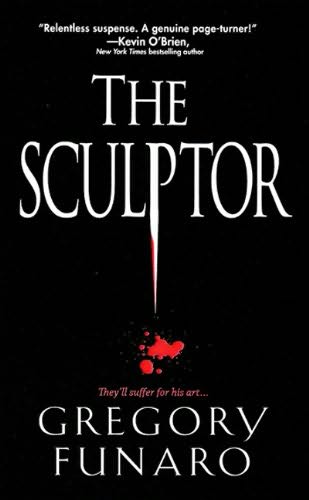
Book #11: The Sculptor

It's not very often that I read thriller/crime type novels, especially when a psychotic serial killer is involved, but I'm really glad I picked up this book. (FYI, I get freaked out pretty easily and have spent most of life being convinced there is a murderer lurking around somewhere close. Reading these kinds of novels just reinforces that, but it's fun to fuel that fire ever now and then.)

In Gregory Funaro's debut novel, The Sculptor, art history professor Cathy Hildebrant finds herself being questioned a consultant in an FBI investigation of a series of murders. The murderer uses humans as "material" to construct insanely detailed reproductions of Michaelangelo's famous sculptures, even using epoxy and paint to make his victims look as if they are made of marble. As the area's foremost scholar on Michaelangelo and the author of a book on his work, Cathy is the obvious choice for helping authorities learn more about The Sculptor's inspiration. It becomes clear that The Sculptor is not only inspired by Michaelangelo, but also by Cathy's book. As the investigation continues, Cathy becomes more and more personally involved with the case, including being chosen to become one of the murderer's next sculptures.


I thoroughly enjoyed this book, and it was one of those stories that I didn't want to stop reading. The story keeps you turning the pages, and the idea of a serial killer modeling his victims as sculptures is pretty unique, at least when taken to the level that this psychopath takes it. Funaro also did his research for this book, which was pretty impressive. Since Cathy was supposed to be an expert on all things Michaelangelo, Funaro had to become an expert, too. I've learned plenty about Michaelangelo in all my years as a history student, but I learned a thing or two from this book. Books that are good and also teach you something -- what's better than that?

The point of view in this novel switches often -- from Cathy to various members of the FBI to the murderer's victims to the murderer himself. I thought it was really interesting that Funaro chose to have The Sculptor as one of the "narrators" of the novel, since that immediately tells the reader who he is. You don't spend the book guessing who it might be -- instead, you're taken into his head, following his thought processes on what victims to choose and why he chooses them, learning how he operates and what horrors he lived through as a child. When I first read a chapter that was in The Sculptor's point of view, I wasn't sure how I felt about it, since it took the mystery away, but as I read, I found that it added another element of suspense... You know who it is, and you know how close the FBI comes to him. Wondering when they will finally pick up on the right clue is what keeps you turning the pages. The only issue I had plot-wise was the inevitable love story... I guess it added some depth to the characters, but seriously, I don't need people to fall in love for me to enjoy a book.

As far as the writing goes, there are a few little things that bugged me here and there... The dialogue was a little unbelievable sometimes, especially coming from Cathy. The way she spoke sometimes sounded more like a prepared lecture she was giving at a conference than the sort of thing she would say of the top of her head while being questioned... I know she's supposed to be an expert and intellectual-type, but come on, no one talks like that, especially not when they're flustered and trying to piece things together bit by bit. Funaro also does this thing where he adds "Yes," or "No," to the beginning of statements of fact, and he does it a lot. Like, "Yes, the Sculptor was indeed pleased with his latest selection" or "No, Dr. Hildebrant couldn't let that happen, not again." Seems like a minor issue, but he uses it so often that I kind of found myself wanting to start counting "yes"es and "no"s.

But hey, for a first novel, I say A+. Great read.

4/5 stars

Read from March 7, 2011 to March 13, 2011

--C

Tuesday, March 1, 2011

Book # 9.5: La Belle et la Bête (Beauty and the Beast)

Beauty and the Beast was one of my favorite Disney movies as a kid (although nothing could ever possibly beat Aladdin), and I recently got to see the Broadway version when the touring cast came through Huntsville. I saw it when I was browsing the classic Kindle books, so I thought I'd read it to see how it compared to the story I know so well.

As is generally the case with Disney movies, they seemed to have taken a very loose idea from the original work and crafted into something kids would like. I don't really have a problem with the way Disney does things, for the most part (see my post on Alice's Adventures in Wonderland). I know they don't stick very closely to the literature or historical themes they choose, but at the very least, they might inspire kids to go back and read the originals just to compare them to the movies they love. Case in point: me.

In Jeanne-Marie Le Prince de Beaumont's La Belle et la Bête, a formerly rich merchant who has become poor stumbles upon a beast's castle. The beast insists that the merchant offer one of his daughters (he has three) in return for his freedom and a trunk full of money. His daughter, nicknamed Beauty, goes to take her father's place in the castle, and she finds that the beast has graciously prepared for her arrival, setting up an apartment for her and coming to dine and chat with her daily. The Beast asks Beauty numerous times to marry him, but she refuses. She longs to see her father again, and the Beast allows her to leave when she promises to return in one week. When she goes home to visit her family, she finds that her sisters have each married handsome, yet dull and uncaring men. She realizes that she loves the Beast regardless of his appearance. She comes back to the castle to find the Beast dying, but when she tells him that she has returned because she wants to marry him, the Beast is revived and turns into a handsome and brilliant prince. Yay.

So... No crazy inventor father for Belle. No Gaston (my favorite character) fighting for Belle's affection. No household items brought to life. No rose quickly losing petals (though the Beast does mention his affinity for roses). No throng of townspeople storming the castle. No wonderfully choreographed showtunes... But all in all, still a nice story. A bit simple, but nice. Definitely worth the hour it will take you to read it.


3/5 stars

Read on February 28, 2011

--C

Monday, February 28, 2011

Book #8: Life From Scratch


You know what the best thing about this book is? It's not about child abuse or people heartlessly killing their mentally challenged friends.

Yes, I chose to read Melissa Ford's Life from Scratch mostly because it pretty much guaranteed that I wasn't going to be insanely depressed for several days after reading it. I needed something light and easy, and that's exactly what I got. I enjoyed reading it, even if it's probably not the most intellectually stimulating thing I've ever picked up.

In Life from Scratch, the 30-something narrator, Rachel, has recently gotten divorced from her workaholic husband, Adam. She pretty much shuts her entire life down for about a year, including quitting her job as a graphic designer. She lives off the money she got from her half of their condo, and she sits around alone in her apartment all day. Awesome. In all her infinite time, she decides to try to teach herself to cook -- something she never learned how to do, because her busy lawyer parents never cooked. Rachel starts a blog to talk about her adventures in cooking, which, of course, also allows her to get some things off her chest about the divorce. Rachel find solace in writing, and her blog becomes very, very popular. Her friends encourage her to hold a dinner party to show off her cooking skills, and lo and behold, she meets a dreamy Spanish dude named Gael. The rest of the book is about Rachel trying to move on with her life, which she hopes will include spending more time with Gael, even though she's clearly still obsessed with Adam.

This book is about as chick-lit as it sounds, although I have to admit, it's very well-written. The plot sounds kind of romance-novel-esque, but it's definitely not. It's not graphic or even sensual, really. It's not really even romantic. It's much more a book about finding yourself and being productive in a way that makes you happy (as opposed to a way that just makes money) than it is about romance.

I'm not a huge fan of Rachel, because, honestly, she's sort of neurotic and insane... Say, for example, creating a fake website to use as bait to figure out Gael's IP address so she can check to see if he reads her blog? Really? Couldn't you just ask him? Or is that too normal? She jumps to conclusions a lot, making huge deals out of nothing... It's really irritating sometimes. She thinks like a teenager. I mean, I've never been in her position, thankfully, so I don't know. Maybe divorce turns you in to a psychotic seventeen-year-old.

Anyway, most importantly, this book made me really hungry. Every time I read it, I was hungry. And I wanted to go into the kitchen and cook something. Not go to McDonalds or open a bag of chips, but cook something. Rachel didn't know anything about cooking gourmet meals, and neither do I, but she did it. I could do that. With all her annoying faults, at least she's inspiring about cooking. Stick to the blog, Rachel!

PS -- The ending? Pfffttt. It's kind of what I was hoping for, but it was still kind of irritating in a "I just read a whole book about a misunderstanding?!?!" sort of way.

3/5 stars

Read from February 23, 2011 to February 27, 2011

--C

Sunday, February 20, 2011

Book #6: Roseflower Creek

Ninety-two reviews on Amazon. Seventy-three of them 5 stars. That's got to be a decent sign, and I have to say I agree with those seventy-three people. The odd thing is how it's possible to love a book so much when it makes you feel completely and utterly terrible.

Jackie Lee Miles' first novel Roseflower Creek is written in the voice of 10-year-old Lori Jean, a poor, uneducated girl growing up in 1950s rural Georgia. You learn in the first sentence of the book that she's dead. She goes back and shares the story of her ten short years of life in broken Southern-ese. This mainly centers around living with her abusive, alcoholic, criminal stepfather, Ray, and her mother, who lets Ray walk all over both of them. On top of Lori Jean's terrible home life, there are many other losses, tragedies, and injustices that she has to face along the way.

Lori Jean's narration is so innocent. She has lived through enough hell to make her grow up faster than she should have, but she talks about her life with all the simplicity that a 10-year-old should have. Miles has written this book beautifully, making it sound exactly like a child in rural Georgia was speaking right into your ear, and certainly makes a strong impact... a big, huge impact... the kind that reaches right into your sternum, rips out your heart, grinds it up in a blender, and feeds it right back to you.

Seriously, the whole book is depressing, but the last 1/4th just made me want to vomit. It's not overly graphic or anything (in my opinion), it's just the thought of a child living through that... I know it's fiction, but Lori Jean is a representation of plenty of children who live like this every day. It's blood-curdling. And what's even harder to understand is how forgiving Lori Jean is. She holds no grudge. She looks at the lives of those who have mistreated her, and she says she understands why they act the way they do, because they, too, were mistreated as a child. That's an interesting point of view from a victim, and it could easily be up for a lot of debate. I think everyone can agree that a troubled childhood doesn't excuse anyone's behavior later in life, even though it may influence their behavior. There are apparently some readers of this book who completely dismissed the entire thing based on Lori Jean's forgiveness of her abusers, saying that it excused the abusive behavior. I don't think that was what Miles was trying to suggest. Not only does it highlight the vicious cycle of abusees becoming abusers, but also having Lori Jean forgive shows how big and selfless her heart was. Thanks to Ray, she was the one who was served the largest portion of injustice, but she was still worried about Ray and what had happened to him to make him the way he was. I don't think Miles was trying to excuse Ray's behavior when she writes about how Lori Jean feels sorry for him. I think she's trying to show how innocent she is. She's a child. Children believe excuses. If anything, it makes me even more angry about how many cases like Lori Jean's are out there that get ignored because of people believing excuses. I think that was the point Miles was trying to make, and even if it wasn't, that's how I took it.

This is definitely worth the read. You've been warned that it's depressing and hard to stomach, but honestly, this is going on all around us. Even if you don't want to hear or think about it, it's happening. All those kids like Lori Jean deserve to be noticed, and this book forces you to do that.

5/5 stars

Read from February 19, 2011 to February 20, 2011

--C

Saturday, February 19, 2011

Book #5: Dreaming Anastasia

Question: What is my favorite, favorite, favorite historical topic?

Answer: The Romanovs and the Bolshevik Revolution

Question: What is my favorite, favorite, favorite thing about that particular topic?

Answer: Anastasia Romanov and the theory that she survived her family being massacred.

Question: What is my favorite, favorite, favorite price for books?

Answer: Free

It should come as no surprise, then, that I had a minor freak-out when I ran across Dreaming Anastasia, a young adult novel by Joy Preble, for freeeee on Kindle a couple weeks ago. (Now it's around $7.00. This is why I check the Top 100 Free Kindle books every other day.)

In Dreaming Anastasia, in the present day, a typical seventeen-year-old named Anne is just going about her average teenage life when she realizes that she's being stalked by this dark, odd dude named Ethan. Then she starts having strange dreams about Grand Duchess Anastasia Romanov being trapped in some hut with a witch. Odd, since Anastasia and her entire family were killed in 1918. Then, even weirder stuff starts happening -- glowing extremities, freaky weather, getting chased by guys with weapons... Eventually, Anne learns that Ethan has come to her so they can help save Anastasia Romanov from a witch popular in Russian folklore. The book shifts between being narrated by Anne, Ethan, and Anastasia herself, who is writing in a journal from captivity.

The Romanovs have always appealed to me... Probably because, although flawed in several ways, they are such a beautiful family and their story is so tragic. For those of you not familiar with their story, it will be my pleasure to give it to you simply and briefly: Czar Nicholas II, of the Romanov dynasty, was the ruler of Russia for a while. He had a lovely wife Alexandra, four daughters (Olga, Maria, Tatiana, and Anastasia) as well as a young son (Alexi) who had hemophilia. Alexi was sick a lot, and a crazy lunatic named Gregory Rasputin managed to weasel his way in to having some degree of power with the royal family because he claimed he had powers that could heal Alexi. Things went rather sour, and eventually Nicholas II was overthrown by the Bolsheviks in the early 1900s. The family was held captive for a while by the Bolsheviks, and eventually they were taken into a basement and killed. Their bodies were burned and buried. Upon excavating the bodies, they never found the remains of Anastasia. So, there are a lot of rumors that she somehow survived or was rescued and lived the rest of her life with a secret identity. There have been a few people who have claimed to be Anastasia, most famously, Anna Anderson, who was later revealed to be lying thanks to DNA.

So. Joy Preble takes this story to a whole new level by adding a few twists... Some family drama, some paranormal activity, some Russian fairy tales. I'm down with it. I'm down with anything Romanov-related. Preble is a high school English teacher (!!!! awesome), and this is her first novel.

I really, really enjoyed this, although I think I can admit that it's definitely not something everyone would enjoy. (I think the intended audience would enjoy it, since it's a young adult book, but I wouldn't recommend it to serious history buffs or probably anyone Russian.) I am definitely biased since I love the topic so much, but everything else about the book was great, too. I really liked Anne most of the time (although she was a little too "Bella Swan"-esque sometimes), and Preble has a very sarcastic tone sometimes that I really enjoyed. Anne's family background and her best friend Tess were great aspects of the story, too. Switching narrators kept things interesting, especially since Ethan and Anne both occasionally pick up on things that the other doesn't.

I would advise history experts or Russian enthusiasts from reading this book because I will admit the historical parts are very basic. The references to Russian culture are pretty obviously American-minded (I mean, what do we know about Russia other than Tolstoy and Fabrege eggs?), and sometimes Anastasia's "journal" entries just sound like a textbook excerpt about the Romanovs -- but! I don't have a problem with that as much as some fancy-pants folks on Amazon apparently do because it. is. a. young. adult. book. It's OK if it's not mind-blowingly enlightening as far as Romanov history is concerned. I'm just glad someone wrote an interesting, entertaining book about Anastasia Romanov so that some teenager somewhere might remember who she is one day, because they probably aren't going to remember it from history class.

...Which brings me to my next point -- My favorite part of the whole book is probably this quote from Anne:

"Normally, world history is not a subject that makes me do back handsprings. Not that I don't like knowing about that stuff. I actually do. But Coach Wicker -- who pretends to teach the class when he's not too busy figuring out football plays on the computer -- is the most singularly boring person I've ever met."

Or maybe it was this (also Anne):

"Why the administration would allow someone to teach honors world history who mispronounces Bogota and can't find Tierra del Fuego on a map because he thinks it's in Peru is a mystery to me."


I will avoid going into further detail there, but let me just say that I totally get those quotes. And I have a feeling Preble being a teacher has a lot to do with why she gets those quotes. I wish her the utmost success and I hope she writes more soon.

Anyway, this book is well worth the $7 it now costs on Kindle, and I would suggest you give it a read. I would also remind you to peruse the free Kindle books quite often, as I have found many a gem.

4/5 stars

Read from February 17, 2011 to February 19, 2001

--C

Thursday, January 6, 2011

Book #2: Sin's Daughter

I'm not really sure what came over me when I downloaded this, because it doesn't sound like anything I would like, the reviews weren't great, and (as someone who admittedly judges books by their covers on a regular basis) that cover is seriously trashy. Should've heeded all of those warnings, because this wasn't really worth my time.

This novella/short story (I'm counting this + the last short story I read as 1 book) is a prequel to Eve Silver's Otherkin trilogy. I'm honestly not sure if this was written and released before the first book, or if was done after. I would wager a guess that it was after, because that would explain the lack of... well, everything. There wasn't any background information, and I felt like I was already supposed to know who the main characters were. If I'd read the first book in the trilogy, I guess I would have.

From what I can tell, these books are about a couple (Amber and Kai) who are both immortal and involved in some sort of "underworld" shenanigans that occasionally bring them to the "topworld." OK. Something happened a long time ago with them, and they fell in love, then they both died... or "died"... then they meet again many years later, although they haven't aged. That's where this story picks up.

It was slow to get started, but then it picked up a lot. I sort of even almost enjoyed it for a while, but then it turned into complete softcore porn. Once Amber and Kai gave in to their "we used to be together, but now I hate you, but really I love you" tension, the rest of the story awkwardly gross.

So, yes. Don't read this. You're welcome.

1/5 Stars

Read from January 4, 2011 to January 5, 2011

--C

Tuesday, January 4, 2011

Book #1.5: Serial

Ok, so this is Book #1.5 because it's just a short story, but I have to review it because I have a lot to say about it.

"Serial" is three-chapter horror story written by Jack Kilborn (the pen name of author J.A. Konrath) and Blake Crouch. I found it on Kindle, and I was immediately sold (... well, it was free, so, "sold") by the beginning of the description:

"Jack Kilborn (aka J.A. Konrath) and Blake Crouch turn their attention to the twin golden rules of hitchhiking:
# 1: Don’t go hitchhiking, because the driver who picks you up could be certifiably crazy.
# 2: Don’t pick up hitchhikers, because the traveler you pick up could be a raving nutcase.
So what if, on some dark, isolated road, Crazy #1 offered a ride to Nutcase #2?"


YES!! What a brilliant premise for a horror story.

Fair warning: it's rather graphic, but that's to be expected. It's well-written and always keeps you interested. The authors don't use the trite, over-used murder tactics... These killers have some pretty interesting ideas. It's one of those books that makes you think, "Man, the guy who thought of this is a sick person." But it's awesome.

I'm not going to talk much about what happens in the story, because it's way more fun for you to find out for yourself (download it for free on your Kindle app of choice). What I do want to talk about is how it was written. I didn't know this until after I read the story, but I respected it a lot more when I found out.

The two authors, Konrath and Crouch, decided to collaborate, and after some emails back and forth, chose a loose topic -- hitchhiking. Basically, Konrath was responsible for writing a chapter about a hitchhiker who is killed by the person who picks him up. Crouch was responsible for writing a chapter about a hitchhiker who kills the person who picks him up. They were not allowed to read each others' chapters until the entire story was complete. For the third chapter, where Killer #1 meets Killer #2, Konrath started the text, then passed it Crouch, and the two authors ping-ponged their story until it was done . But I repeat, they had not read each others' first chapters when they finished the story. This is mind-blowing to me. The story got so much cooler after I found that out.

Really, really great short story. Some of the reviews on Amazon are really bad, and I can't figure out why. I didn't see anything wrong with it, nothing boring, nothing cheesy. Can't recommend it enough.

5/5 Stars

Read on January 3, 2011.

--C

Monday, January 3, 2011

Book #1: Sweetie

Ahhh, my first book of 2011. It was a lovely way to start the new year.

Sweetie by Kathryn Magendie takes place in smalltown North Carolina, where a young girl named Sweetie occasionally comes out of her rugged, earthen lifestyle in the mountains to attend the local elementary school. The entire town thinks Sweetie is either crazy, evil, or both. The town has been gossiping about Sweetie's family, holed up in the woods, for decades. Melissa, one of Sweetie's classmates, is also an outcast. Although Melissa comes from a well-to-do family with a pretentious, overbearing mother, she doesn't fit in with the other students because of her weight and a nervous stutter. Over the summer, the two girls, against all odds, form a bond that, the story proves, is impossible to break.

This is a classic tale of unconditional friendship. Even though it's the story of two pre-teen girls, the issues are very adult -- it would touch a person of any age. It's definitely a coming-of-age story that teaches an important lesson about where you should put your loyalties. Even though Melissa loves Sweetie more than anything, there are times with the stigma associated with Sweetie and her lifestyle make Melissa turn away in attempts to become more popular. It seems like juvenile subject matter (it's not -- this book is not written for young adults), but it's the underlying message that's important.

It reminded me a little of Stargirl by Jerry Spinelli. It's sort of the adult version of the same basic idea. I loved it. Magendie certainly has a way with words, and she tells this story beautifully. I highly suggest downloading this one on your Kindle -- it's free right now, but well worth much more than that.

4/5 Stars

Read from January 1, 2011 to January 3, 2011

--C